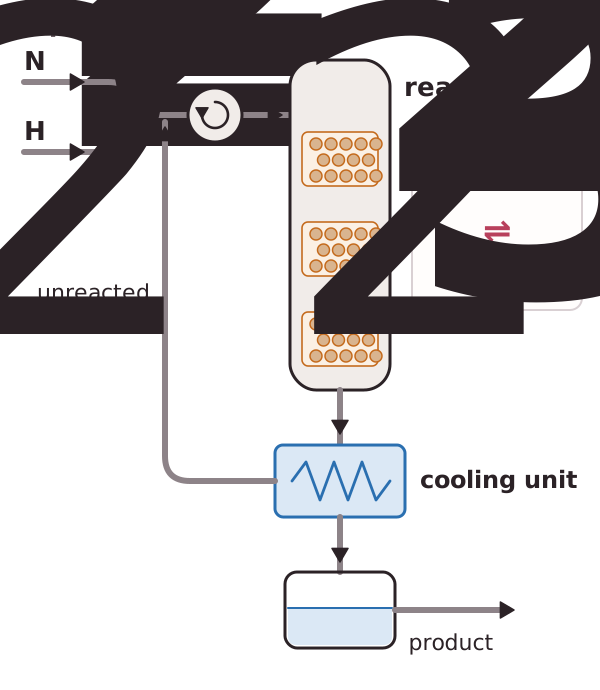
The Haber process makes ammonia from nitrogen and hydrogen. The conditions are a temperature of 450 °C, a pressure of 200 atmospheres and an iron catalyst. Nitrogen and hydrogen are mixed in the ratio one to three, matching the equation N2 + 3H2 ⇌ 2NH3.
The reaction is reversible, so only some of the nitrogen and hydrogen turns into ammonia each time the gases pass through the reactor. The mixture leaving the reactor is cooled. Ammonia has a higher boiling point than nitrogen and hydrogen, so it condenses to a liquid and is removed. The unreacted nitrogen and hydrogen are recycled back into the reactor.
The iron catalyst speeds up the reaction so that equilibrium is reached sooner. A catalyst does not change the yield of ammonia at equilibrium. The temperature and pressure are chosen to give a reasonable yield at a reasonable rate without making the process too costly.