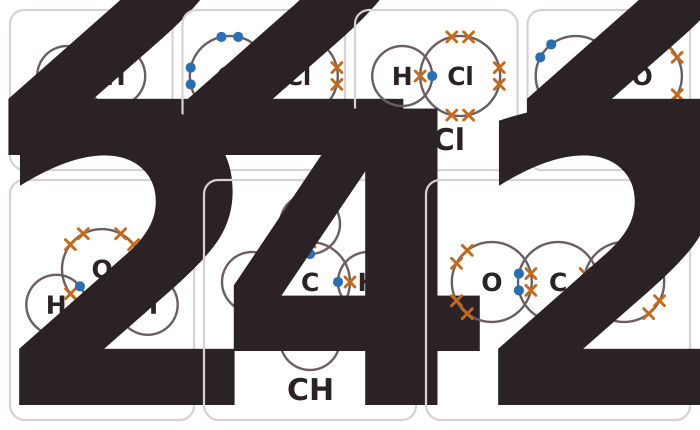
A covalent bond forms when two atoms share a pair of electrons. The shared pair is attracted to the nuclei of both atoms, and this holds the atoms together. Non-metal atoms bond in this way, and a group of atoms joined by covalent bonds is a molecule.
A dot and cross diagram shows only the outer shell. The outer electrons of one atom are drawn as dots and those of the other atom as crosses, so you can see where each shared electron came from. Each atom ends up with a full outer shell.
- Hydrogen, H2: two atoms share one pair of electrons, a single bond.
- Hydrogen chloride, HCl: one shared pair. The chlorine atom also has three pairs of outer electrons that are not shared.
- Water, H2O: oxygen shares two pairs, one with each hydrogen atom, and has two pairs that are not shared.
- Methane, CH4: carbon shares four pairs, one with each hydrogen atom.
- Oxygen, O2: the atoms share two pairs of electrons, which makes a double bond.
- Carbon dioxide, CO2: carbon forms a double bond with each oxygen atom.