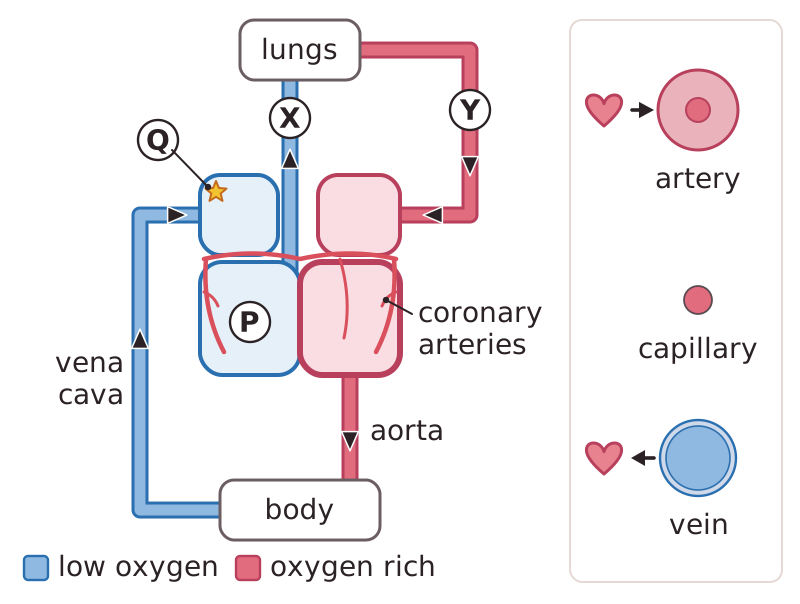
The heart is an organ that pumps blood around the body in a double circulatory system. This means blood passes through the heart twice on each complete trip around the body. The right ventricle pumps blood to the lungs through the pulmonary artery, and gas exchange takes place there. Blood comes back to the heart from the lungs in the pulmonary vein. The left ventricle then pumps blood around the rest of the body through the aorta, and blood returns to the heart through the vena cava. The heart muscle has its own blood supply from the coronary arteries. You do not need to know the names of the heart valves.
Air reaches the lungs through the trachea, which splits into two bronchi. The bronchi lead to the alveoli, tiny air sacs where gas exchange happens. Each alveolus is surrounded by a network of capillaries. The lungs are adapted for gaseous exchange by having a very large surface area from millions of alveoli, walls that are only one cell thick, and a rich blood supply. Oxygen diffuses from the air into the blood and carbon dioxide diffuses the other way.
The natural resting heart rate is controlled by a group of cells in the right atrium that act as a pacemaker. An artificial pacemaker is an electrical device that corrects irregularities in the heart rate.
There are three types of blood vessel. Arteries carry blood away from the heart at high pressure, so they have thick, muscular and elastic walls and a narrow lumen. Veins carry blood to the heart at low pressure, so they have thinner walls, a wider lumen and valves that stop the blood flowing backwards. Capillaries are tiny vessels that link arteries to veins. Their walls are one cell thick, so substances can diffuse quickly between the blood and the body cells. The rate of blood flow is the volume of blood divided by the time. For example, 300 cm3 of blood passing in 60 seconds is a rate of 5 cm3 per second.