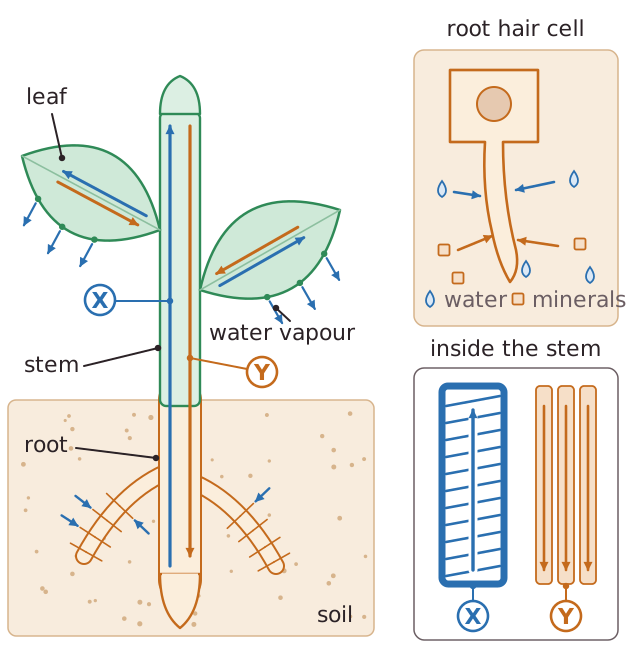
The roots, stem and leaves together form a plant organ system that transports water, mineral ions and sugars around the plant. Each part has structures adapted to its role.
Root hair cells have a long, thin extension that gives them a large surface area for taking in water and mineral ions. Water enters by osmosis. Mineral ions are taken in by active transport. Xylem then carries the water and mineral ions upwards to the stem and leaves. Xylem is made of hollow tubes strengthened with lignin, so water flows through easily and the walls do not collapse. Phloem carries dissolved sugars from the leaves to the parts of the plant that need them, or to storage. This movement is called translocation.
Water travels up the xylem in the transpiration stream. Transpiration is the loss of water vapour from the leaf, mostly through the stomata. The stomata must open to let carbon dioxide in for photosynthesis, so some water is always lost as well.
Transpiration is faster at a higher temperature, in drier air, with more air movement and in brighter light. Warmth speeds up evaporation, dry moving air removes water vapour from around the leaf, and light makes the stomata open. The rate can be measured by how much water the plant takes up: rate = volume of water taken up / time. A plant that takes up 12 cm3 of water in 40 minutes has a rate of 0.3 cm3 per minute.