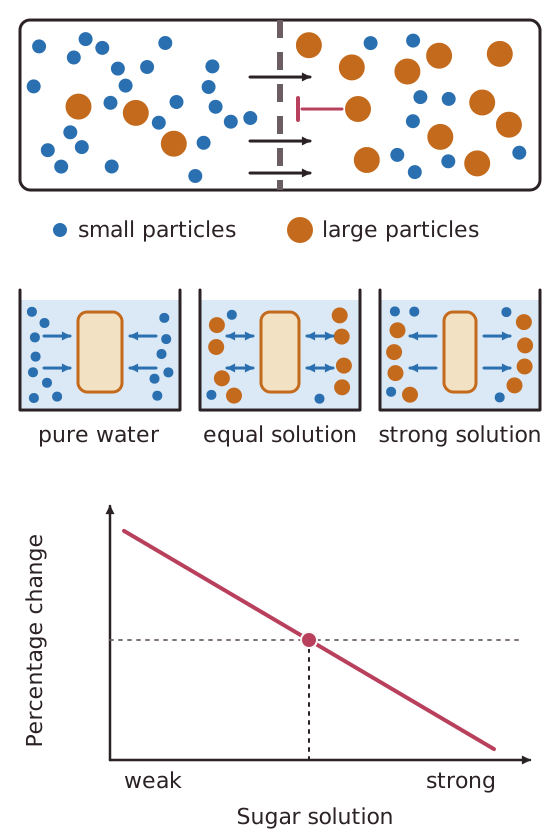
Osmosis is the diffusion of water from a dilute solution to a concentrated solution through a partially permeable membrane. The membrane lets small water molecules pass but does not let larger solute particles through. Water therefore moves from the side with more water (the dilute solution) to the side with less water (the concentrated solution), until the two sides are balanced.
Osmosis explains what happens to plant tissue in different solutions. If a piece of potato is placed in pure water, which is more dilute than the cell contents, water moves into the cells and the potato gains mass. If it is placed in a strong sugar or salt solution, water moves out of the cells and the potato loses mass. If the solution has the same concentration as the cells, there is no overall change in mass.
In the required practical, you cut identical pieces of plant tissue, such as potato cylinders, and dry and weigh each one. You place them in a range of concentrations of salt or sugar solution, leave them for the same time at the same temperature, then dry and weigh them again. The independent variable is the concentration of the solution and the dependent variable is the change in mass. Plotting percentage change in mass against concentration gives a graph, and where the line crosses zero the solution matches the concentration inside the cells.
Percentage change in mass = (final mass − initial mass) ÷ initial mass × 100. A cylinder that goes from 5.0 g to 4.0 g has changed by −1.0 ÷ 5.0 × 100 = −20%, which is a 20% loss. A rate of water uptake is a compound measure, for example grams of water gained per minute.