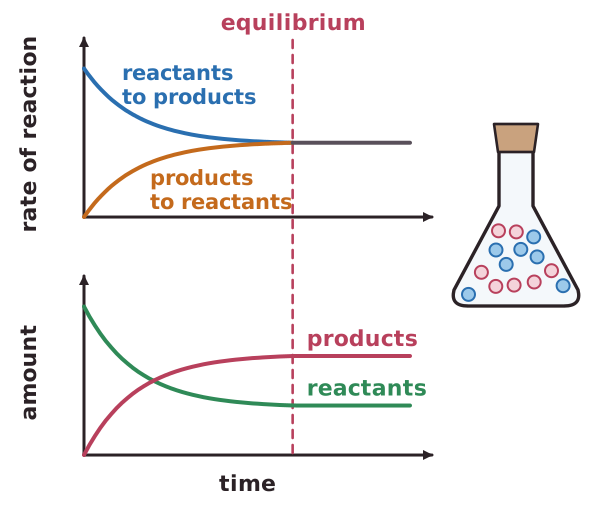
Imagine a reversible reaction in a closed system, where no substances can enter or leave. At the start there are only reactants, so the forward reaction is fast and the reverse reaction has nothing to work on. As the reactants are used up the forward reaction slows down. As more products form the reverse reaction speeds up.
Eventually the rate of the forward reaction becomes equal to the rate of the reverse reaction. The reaction is now at dynamic equilibrium. From this point the concentrations of the reactants and the products stay constant.
The word dynamic matters. The reactions have not stopped. The forward and reverse reactions both continue to take place, at the same rate, so one is exactly cancelling out the other. It is a common mistake to think that the concentrations are equal at equilibrium. They are constant, but they are not necessarily equal, and there may be much more product than reactant or the other way round.
The system must be closed. If a product can escape, for example as a gas from an open container, the reverse reaction cannot keep up and equilibrium is never reached.