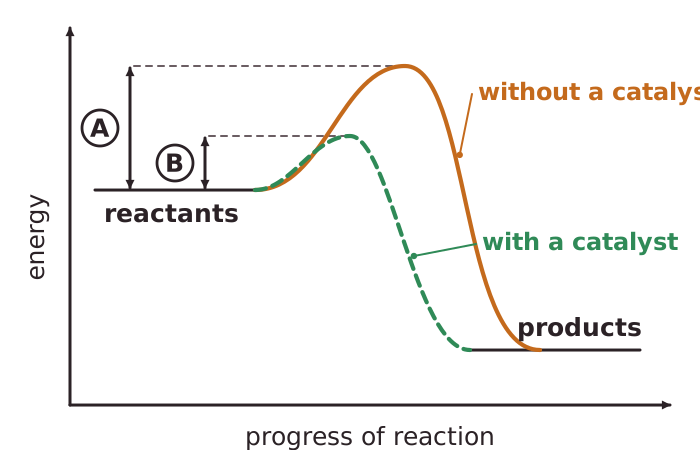
Particles only react when they collide with at least a minimum amount of energy, called the activation energy. A reaction profile plots energy against the progress of a reaction. The reactants sit at one energy level, the curve rises to a peak, then falls to the products. The activation energy is the height from the reactants up to the peak.
A catalyst provides an alternative pathway for the reaction that has a lower activation energy. On a reaction profile the catalysed curve has a lower peak. The reactants and products are at the same levels as before, so the overall energy change of the reaction is unchanged. An exothermic reaction is still exothermic and gives out the same amount of energy.
Because the activation energy is lower, a greater proportion of colliding particles have enough energy to react. There are more successful collisions each second, so the rate of reaction increases and the reaction is faster. The catalyst does not give the particles more energy, and it does not change how much product is made in the end.