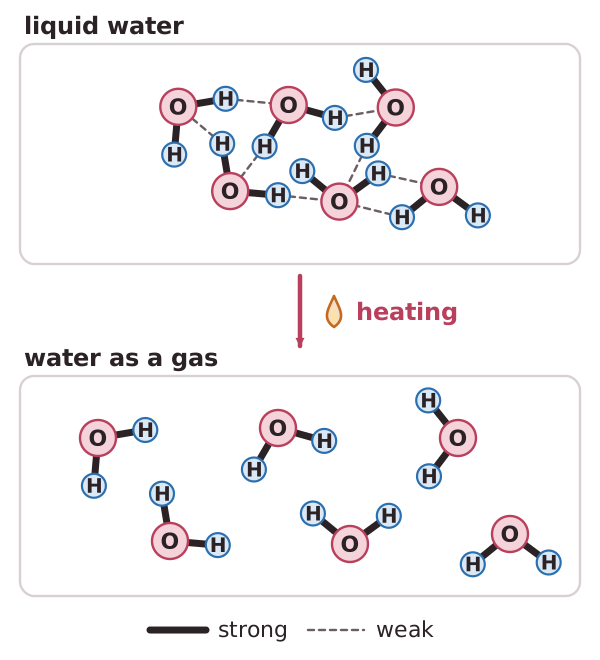
When a substance melts or boils, energy is transferred to its particles from the surroundings. This energy is used to overcome the forces holding the particles together, not to make them move faster, which is why the temperature stays constant while a substance changes state. The stronger the forces, the more energy is needed, so the higher the melting point and boiling point.
In a simple molecular substance such as water or methane, the atoms inside each molecule are held by strong covalent bonds, but the molecules are attracted to each other by weak intermolecular forces. When the substance melts or boils only these weak forces are overcome. The covalent bonds do not break. Little energy is needed, so simple molecular substances have low melting points and boiling points. Larger molecules have stronger intermolecular forces, so their boiling points are higher.
In giant structures the particles are held by strong bonds that must be overcome to melt the substance. Sodium chloride has strong ionic bonds between its ions and melts at 801 °C, while water melts at 0 °C. Diamond has strong covalent bonds and metals have strong metallic bonds, so these also have very high melting points.