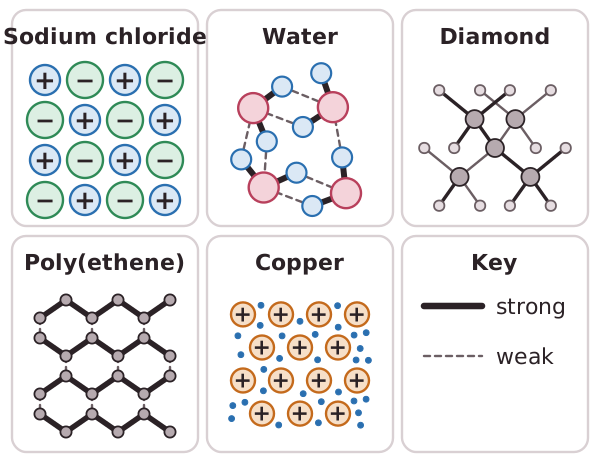
The bulk properties of a material, such as melting point, hardness and electrical conductivity, come from the way its particles are bonded and arranged. They are not properties of single atoms. One copper atom is not shiny and does not conduct electricity. The properties only appear when very many atoms are bonded together.
Ionic compounds have a giant lattice of oppositely charged ions held by strong forces, so they have high melting points. They conduct electricity when molten or dissolved in water because the ions are free to move, but not when solid because the ions are fixed in the lattice. Simple molecules have strong covalent bonds inside each molecule but weak intermolecular forces between molecules, so they have low melting points. They do not conduct because they have no free charged particles.
Giant covalent structures, such as diamond and silicon dioxide, have a network of strong covalent bonds, so they have very high melting points. Polymers are very long molecules with strong covalent bonds between their atoms. The intermolecular forces between long chains are stronger than between small molecules, so most polymers are solids at room temperature.
Metals have layers of positive ions surrounded by delocalised electrons. The strong metallic bonding gives high melting points. The delocalised electrons carry charge, so metals conduct electricity, and the layers of ions can slide over each other so metals can be bent into shape.