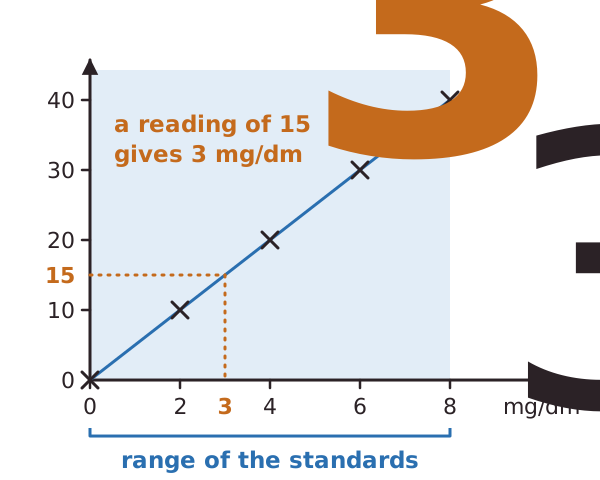
A flame photometer is an instrument that gives a measured reading for the metal ions in a dilute solution. You do not need to know how it works, only how to use the data.
To find a concentration you first make up solutions of known concentration, called standards, and record the reading for each. Plotting reading (vertical axis) against concentration (horizontal axis) gives a calibration curve. To use it, find the sample's reading on the vertical axis, go across to the curve, then down to read the concentration. Example: if standards of 0, 2, 4, 6 and 8 mg/dm3 give readings 0, 10, 20, 30 and 40 on a straight line through the origin, then a sample reading of 15 means a concentration of 3 mg/dm3.
The sample's reading must lie inside the range of the standards. If it is higher than the highest standard, the sample should be diluted, measured again, and the answer multiplied by the dilution factor.
To identify a metal ion, compare the data with reference data. Each metal ion gives peaks at its own characteristic wavelengths. For example, sodium has a strong peak at 589 nm, lithium at 671 nm and potassium at 766 nm. A sample with a strong peak at 589 nm matches the reference value for sodium.