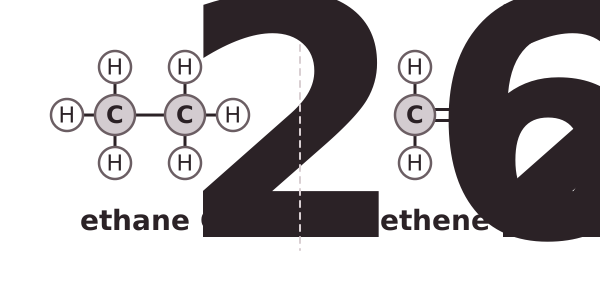
A hydrocarbon is a compound made only of carbon and hydrogen atoms. Alkanes are hydrocarbons, but that is not what makes them saturated.
In an alkane every bond between carbon atoms is a single covalent bond. Each carbon atom forms four bonds, which is the most it can make, so it is holding as many other atoms as it possibly can. There is no spare bonding capacity left, so no more atoms can be added to the molecule without breaking it apart. This is what saturated means.
This is why the number of hydrogen atoms is the maximum for the number of carbon atoms, which gives the general formula CnH2n+2. Ethane, C2H6, is saturated. Ethene, C2H4, has two fewer hydrogen atoms because its carbon atoms are joined by a double bond, so it is not saturated, and more atoms can be added across that double bond.