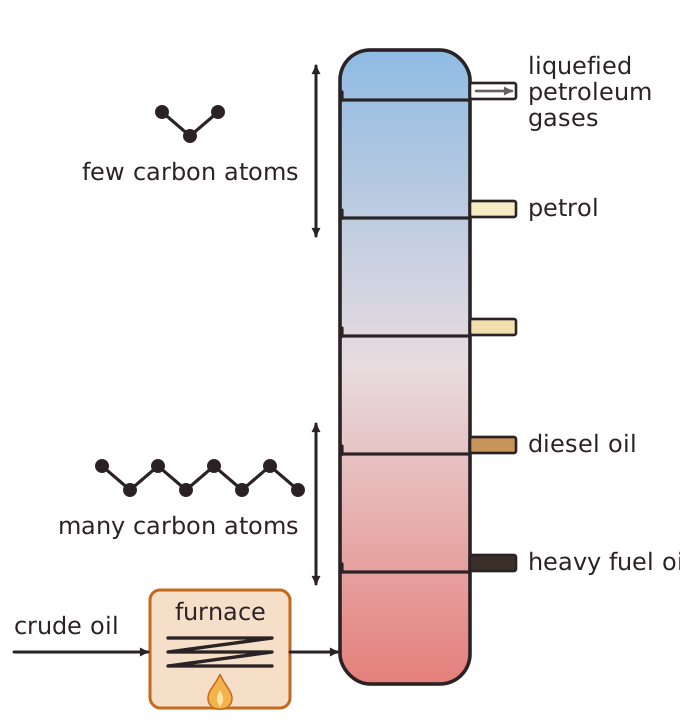
The many hydrocarbons in crude oil are separated into fractions by fractional distillation. Each fraction contains molecules with a similar number of carbon atoms, so they have similar boiling points.
The crude oil is heated until most of it evaporates. The vapours pass into a fractionating column, which is hot at the bottom and cooler towards the top. The vapours rise, and each hydrocarbon condenses back into a liquid when it reaches a part of the column that is cooler than its boiling point. Molecules with small numbers of carbon atoms have low boiling points, so they stay as a gas for longest and condense near the top. Molecules with large numbers of carbon atoms have high boiling points, so they condense near the bottom. The process depends on evaporation and condensation, not on any chemical reaction.
The fractions are processed to make fuels and feedstock for the petrochemical industry. Fuels from crude oil include petrol, diesel oil, kerosene, heavy fuel oil and liquefied petroleum gases. The petrochemical industry uses feedstock to make useful materials such as solvents, lubricants, polymers and detergents.
There is a vast array of natural and synthetic carbon compounds. This is because carbon atoms can form families of similar compounds, such as the alkanes.