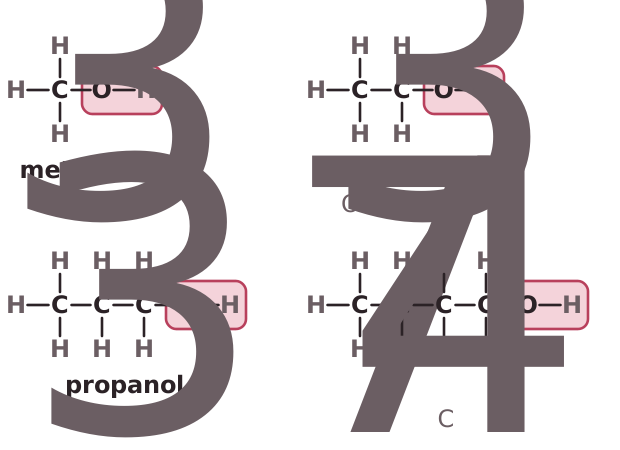
Alcohols contain the functional group -OH. The first four members of the homologous series are methanol (CH3OH), ethanol (CH3CH2OH), propanol (C3H7OH) and butanol (C4H9OH). Their names end in -ol.
The first four alcohols behave in these ways. With sodium they fizz, giving off hydrogen gas, and the sodium dissolves, less violently than in water. They burn in air to give carbon dioxide and water: C2H5OH + 3O2 → 2CO2 + 3H2O. They dissolve in water to give a neutral solution. With an oxidising agent such as acidified potassium dichromate, an alcohol is oxidised to a carboxylic acid, and the orange mixture turns green. Ethanol becomes ethanoic acid.
Alcohols are used as fuels and as solvents, and ethanol is the alcohol in alcoholic drinks. Fermentation makes an aqueous solution of ethanol: yeast turns sugar in solution into ethanol and carbon dioxide. The conditions are a warm temperature of about 30 °C and no oxygen. Too cold and the reaction is slow, too hot and the enzymes in the yeast are destroyed, and with oxygen present the ethanol would be oxidised.