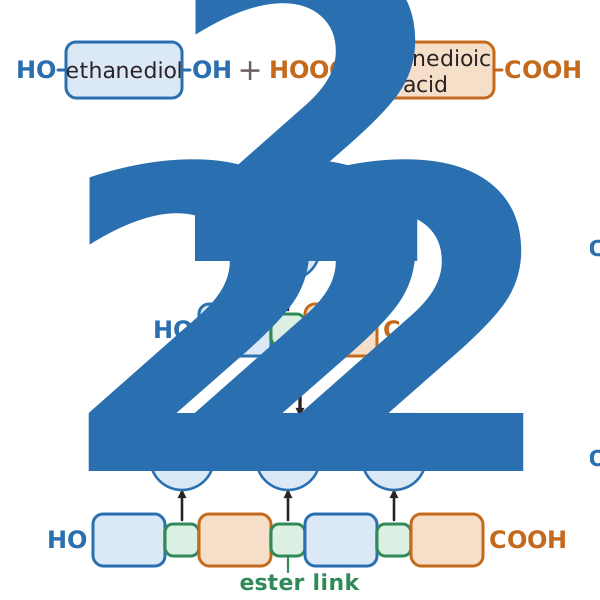
Condensation polymerisation involves monomers that each have two functional groups. When these monomers react they join together and usually lose a small molecule, such as water. Because a small molecule is lost, the reactions are called condensation reactions.
The simplest condensation polymers are made from two different monomers, where each monomer has two of the same functional group. For example, ethanediol has two alcohol (-OH) groups, and hexanedioic acid has two carboxylic acid (-COOH) groups. They polymerise to make a polyester. Each time an -OH group reacts with a -COOH group, an ester link forms and one molecule of water is lost.
The two monomers alternate along the chain, so the repeating unit contains atoms from both monomers. It has fewer atoms than the two monomers added together, because the water has been lost. This is different from addition polymerisation, where the repeating unit has the same atoms as the monomer.