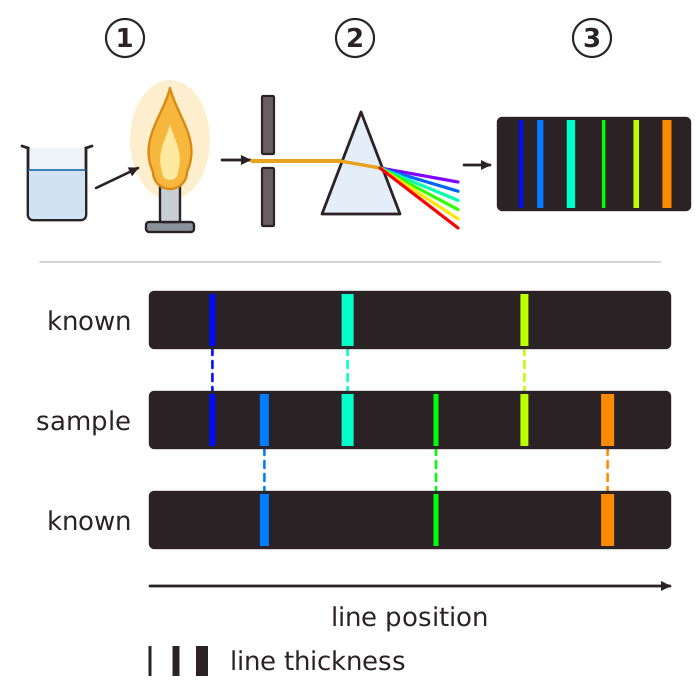
Flame emission spectroscopy is an instrumental method used to analyse metal ions in solutions. Instrumental methods are accurate, sensitive and rapid, so they can give a result from a very small sample in a short time.
The sample solution is put into a flame. The metal ions in it give out light. This light is passed through a spectroscope, which splits it up. The output is a line spectrum: a set of separate coloured lines at particular wavelengths. Each metal ion gives its own pattern of lines, so the spectrum can be used to identify which metal ions are in the solution.
The spectrum also shows how much of the ion is present. The more concentrated the solution, the brighter the lines, so the output can be used to measure the concentration of the metal ions.
To interpret a result, you compare the line spectrum of the sample with a reference set of spectra for known metal ions, given in the same form. If every line in a reference spectrum appears in the sample, that metal ion is present. If the sample shows lines from two different reference spectra, it contains a mixture of two metal ions. You may be given the result as a chart or as a table of line positions.