Skip to content

Ionisation Energy

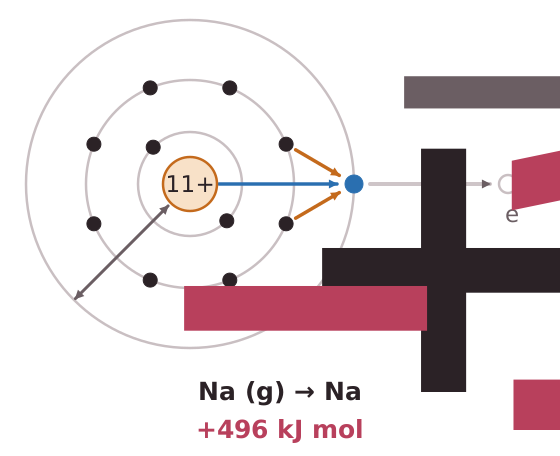
The first ionisation energy is the energy required to remove one electron from each atom in one mole of gaseous atoms of an element to form one mole of gaseous +1 ions.

Na (g) → Na+(g) + e-  +496kJmol-1

The atomic radius has a large effect. The greater the distance of the outer electrons from the nucleus the less the nuclear attraction.A larger Nuclear charge increases the ionisation energy, the more protons there are, the greater the nuclear attraction.
The repulsion of the outer electrons by inner shell electrons is called the shielding effect and reduces the nuclear attraction.
Read the text

Read the text and highlight anything you think is important. When you go on, the text is hidden and you answer from memory.

Specification: OCR Chemistry A (H032), AS-level, 3.1.1 Periodicity. Topic: Periodicity.

Key terms in this lesson

Ion
A positively or negatively charged atom or group of atoms, formed by the loss or gain of electrons.
Ionisation
The loss or gain of electrons by an atom or molecule to form a charged ion.
Electron shell
A main energy level occupied by electrons, given a principal quantum number n, with n = 1 closest to and lowest in energy relative to the nucleus.
Mole
The amount of substance that contains as many particles as there are atoms in exactly 12g of carbon-12.

More in Periodicity

All 14 lessons in Periodicity · All OCR AS-level Chemistry topics