Skip to content

Using a Separating Funnel

The crude product of an organic reaction is often mixed with an aqueous solution. Most organic liquids are immiscible with water, so the two form separate layers. A separating funnel is used to remove the organic layer from the aqueous layer.With the tap closed, the mixture is poured into the funnel. The funnel is stoppered, inverted and shaken gently, and the tap is opened now and then to release pressure. It is then clamped upright until two clear layers form. The denser liquid is the lower layer.
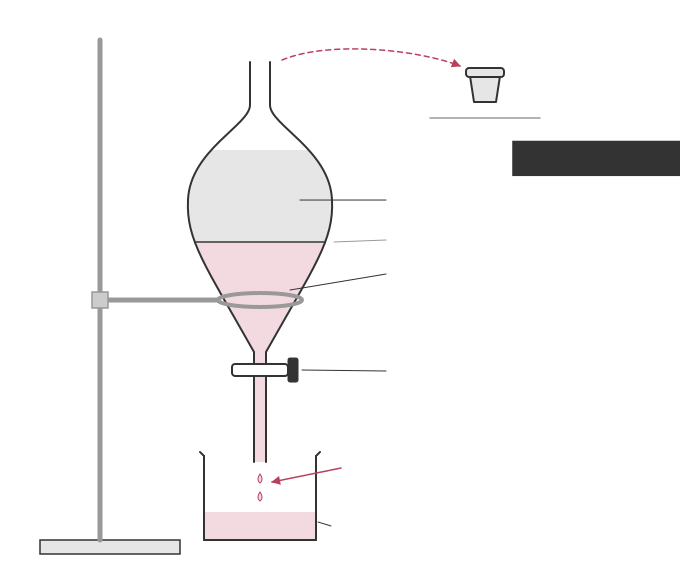
To drain the lower layer, first remove the stopper (otherwise air cannot get in and the liquid will not run out). Open the tap, run the lower layer into a beaker and close the tap as the boundary reaches it. The upper layer is then poured out of the top into a separate container.If you are not sure which layer is which, add a little water: the aqueous layer is the one that increases in volume.The organic layer is often washed in the funnel. Shaking with aqueous sodium hydrogencarbonate removes acidic impurities; carbon dioxide gas is produced, so the pressure must be released often. Shaking with water removes water-soluble impurities.Example: 1-bromobutane (density 1.27 g cm−3) is shaken with water (density 1.00 g cm−3). The 1-bromobutane is denser, so it forms the lower layer and is run off through the tap.

Read the text

Read the text and highlight anything you think is important. When you go on, the text is hidden and you answer from memory.

Specification: OCR Chemistry A (H032), AS-level, 4.2.3 Organic synthesis. Topic: Organic Synthesis.

Key terms in this lesson

immiscible
Describes two liquids that do not mix but form separate layers.

More in Organic Synthesis

All 8 lessons in Organic Synthesis · All OCR AS-level Chemistry topics