After washing and drying, an organic liquid is nearly pure but may still contain other organic compounds, such as unreacted starting material or side products. The final step is redistillation: the dried liquid is distilled again and only the fraction that boils at the product's boiling point is collected.The dried liquid is heated in a clean, dry flask with anti-bumping granules in distillation apparatus, and the thermometer is watched closely. Liquid that distils below the product's boiling point is collected separately and discarded. When the temperature reaches the boiling point, a fresh, weighed collecting flask is used. Collection stops when the temperature rises above the range, leaving higher-boiling impurities in the flask. A narrow range, typically within about 2 °C of the boiling point, is collected.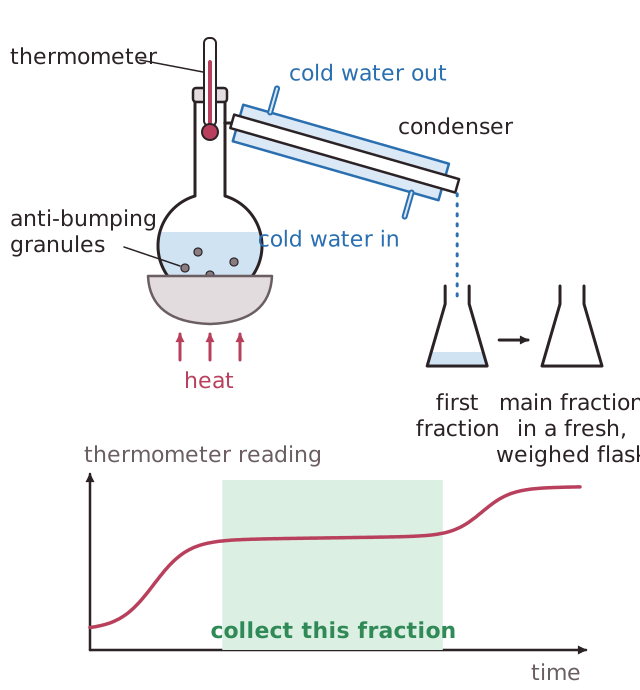 A pure liquid boils at a fixed temperature, so a steady thermometer reading during collection suggests the product is pure. Impurities usually make a liquid boil over a wider range.Overall sequence for an organic liquid: react (often under reflux) → distil → wash in a separating funnel → dry with an anhydrous salt → redistil.Worked example: a student prepares 1-bromobutane (boiling point 102 °C). During redistillation they collect the fraction boiling at about 100 to 104 °C; liquid distilling at 80 °C is a lower-boiling impurity and is discarded. They collect 8.2 g, and the maximum possible mass is 13.7 g.
percentage yield = 8.2 ÷ 13.7 × 100 = 60%
A pure liquid boils at a fixed temperature, so a steady thermometer reading during collection suggests the product is pure. Impurities usually make a liquid boil over a wider range.Overall sequence for an organic liquid: react (often under reflux) → distil → wash in a separating funnel → dry with an anhydrous salt → redistil.Worked example: a student prepares 1-bromobutane (boiling point 102 °C). During redistillation they collect the fraction boiling at about 100 to 104 °C; liquid distilling at 80 °C is a lower-boiling impurity and is discarded. They collect 8.2 g, and the maximum possible mass is 13.7 g.