Heating under reflux lets a reaction mixture be heated for a long time without losing volatile reactants or products. It is used for organic reactions that are slow at room temperature, such as oxidising a primary alcohol to a carboxylic acid or hydrolysing a haloalkane.Apparatus (Quickfit)
A round-bottomed or pear-shaped flask containing the reaction mixture and a few anti-bumping granules.
A Liebig condenser fitted vertically into the neck of the flask.
An electric heater (heating mantle) or water bath as the heat source.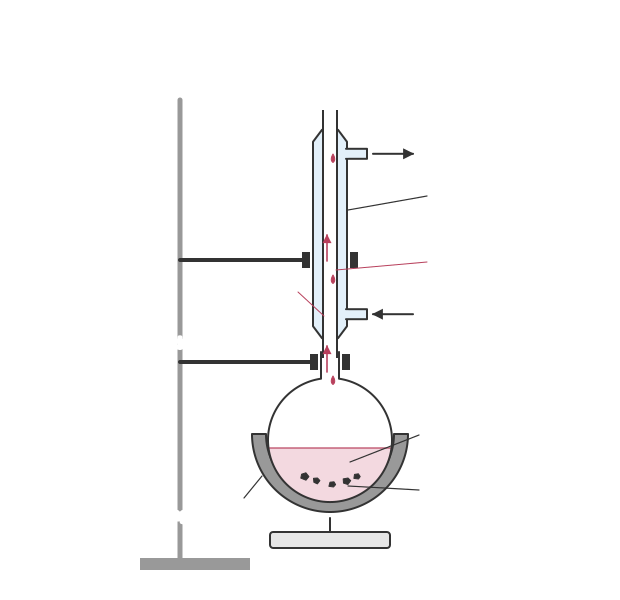
As the mixture boils, vapour rises into the condenser. Cold water flowing through the outer jacket cools the vapour, which condenses and drips back into the flask. The mixture is boiled and condensed continuously, so the reaction can go to completion.Key practical points
Water enters the condenser at the bottom and leaves at the top, so the jacket stays full of cold water.
The top of the condenser must be open, never stoppered, or pressure builds up and the apparatus could burst.
Anti-bumping granules stop large bubbles forming suddenly and give smooth boiling.
Organic liquids are usually flammable, so a naked flame is not used; reflux also keeps the vapour inside the apparatus.
The flask is clamped at the neck.Worked example: ethanol is oxidised to ethanoic acid by heating with excess acidified potassium dichromate(VI). Why is reflux used rather than distillation?
Ethanal forms first and boils at only 21 °C. Under reflux it condenses and returns to the flask, where it is oxidised further to ethanoic acid. With distillation, the ethanal would escape before it could be oxidised.
A round-bottomed or pear-shaped flask containing the reaction mixture and a few anti-bumping granules.
A Liebig condenser fitted vertically into the neck of the flask.
An electric heater (heating mantle) or water bath as the heat source.
As the mixture boils, vapour rises into the condenser. Cold water flowing through the outer jacket cools the vapour, which condenses and drips back into the flask. The mixture is boiled and condensed continuously, so the reaction can go to completion.Key practical points
Water enters the condenser at the bottom and leaves at the top, so the jacket stays full of cold water.
The top of the condenser must be open, never stoppered, or pressure builds up and the apparatus could burst.
Anti-bumping granules stop large bubbles forming suddenly and give smooth boiling.
Organic liquids are usually flammable, so a naked flame is not used; reflux also keeps the vapour inside the apparatus.
The flask is clamped at the neck.Worked example: ethanol is oxidised to ethanoic acid by heating with excess acidified potassium dichromate(VI). Why is reflux used rather than distillation?
Ethanal forms first and boils at only 21 °C. Under reflux it condenses and returns to the flask, where it is oxidised further to ethanoic acid. With distillation, the ethanal would escape before it could be oxidised.