Industry needs a high yield, a fast rate, low costs and safe operation. These aims often conflict, so compromise conditions are chosen.The Haber processN2(g) + 3H2(g) ⇌ 2NH3(g) ΔH = −92 kJ mol−1 • Temperature, about 450 °C. The forward reaction is exothermic, so a low temperature gives a higher equilibrium yield. But at low temperature the rate is too slow. 450 °C is a compromise between yield and rate.
• Pressure, about 200 atm. There are fewer gas molecules on the right (2 compared with 4), so high pressure increases both the yield and the rate. Higher pressures are not used because the equipment and the energy for compression cost too much, and the risk of leaks and explosions increases.
• Iron catalyst. This increases the rate so that an acceptable rate is reached at a lower temperature. It does not change the yield.Only about 15% of the nitrogen and hydrogen is converted in each pass. The ammonia is removed by cooling it until it liquefies, and the unreacted gases are recycled, so the overall conversion is very high.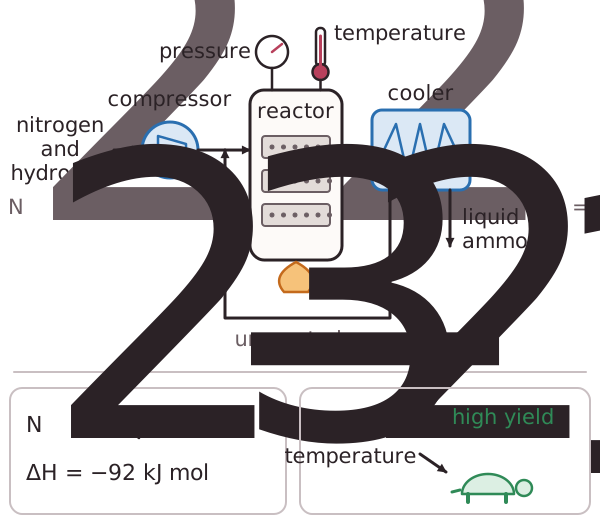 Hydration of ethene to make ethanol
C2H4(g) + H2O(g) ⇌ C2H5OH(g) ΔH = −45 kJ mol−1 The conditions are about 300 °C, 60 atm and a phosphoric acid catalyst. Again, the temperature is a compromise between yield and rate. Higher pressure would increase the yield, but it is expensive and makes ethene polymerise. Unreacted ethene is recycled.In both cases the aim is the most product per unit time at acceptable cost.
• Pressure, about 200 atm. There are fewer gas molecules on the right (2 compared with 4), so high pressure increases both the yield and the rate. Higher pressures are not used because the equipment and the energy for compression cost too much, and the risk of leaks and explosions increases.
• Iron catalyst. This increases the rate so that an acceptable rate is reached at a lower temperature. It does not change the yield.Only about 15% of the nitrogen and hydrogen is converted in each pass. The ammonia is removed by cooling it until it liquefies, and the unreacted gases are recycled, so the overall conversion is very high.
Hydration of ethene to make ethanol