Sulfuric acid is made by the Contact process. It is one of the most widely manufactured chemicals, used for fertilisers, paints, detergents and many other products.Stage 1. Sulfur is burned in air to form sulfur dioxide:S(s) + O2(g) → SO2(g) Stage 2. Sulfur dioxide is oxidised to sulfur trioxide in a reversible reaction:2SO2(g) + O2(g) ⇌ 2SO3(g) ΔH = −197 kJ mol−1 • Temperature, about 450 °C. The forward reaction is exothermic, so a lower temperature would give a higher yield, but the rate would be too slow. 450 °C is a compromise.
• Pressure, about 1 to 2 atm. There are 3 gas molecules on the left and 2 on the right, so high pressure would increase the yield. But the conversion is already about 99% at low pressure (the gases pass over several catalyst beds), so the extra cost of high pressure is not worthwhile.
• Catalyst: vanadium(V) oxide, V2O5. This increases the rate without changing the yield.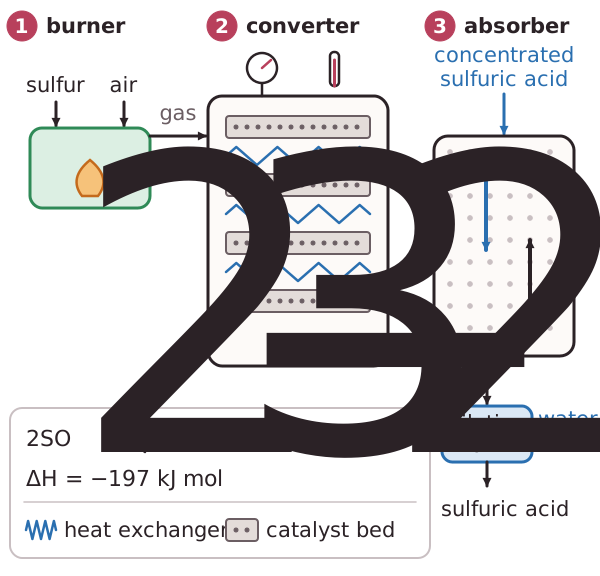 Stage 3. Sulfur trioxide is not added directly to water, because the reaction is so exothermic that it forms a fine mist of sulfuric acid that is hard to collect. Instead it is absorbed in concentrated sulfuric acid to form oleum, which is then diluted with water:
SO3(g) + H2SO4(l) → H2S2O7(l) H2S2O7(l) + H2O(l) → 2H2SO4(l)
• Pressure, about 1 to 2 atm. There are 3 gas molecules on the left and 2 on the right, so high pressure would increase the yield. But the conversion is already about 99% at low pressure (the gases pass over several catalyst beds), so the extra cost of high pressure is not worthwhile.
• Catalyst: vanadium(V) oxide, V2O5. This increases the rate without changing the yield.
Stage 3. Sulfur trioxide is not added directly to water, because the reaction is so exothermic that it forms a fine mist of sulfuric acid that is hard to collect. Instead it is absorbed in concentrated sulfuric acid to form oleum, which is then diluted with water: