Skip to content

Mass Spectrum Example 4

Example 4: chloroethane, CH3CH2ClChlorine has two isotopes, chlorine-35 and chlorine-37, which occur in the ratio of about 3:1. Any ion that contains one chlorine atom therefore appears as a pair of peaks 2 units apart, with heights in the ratio 3:1.
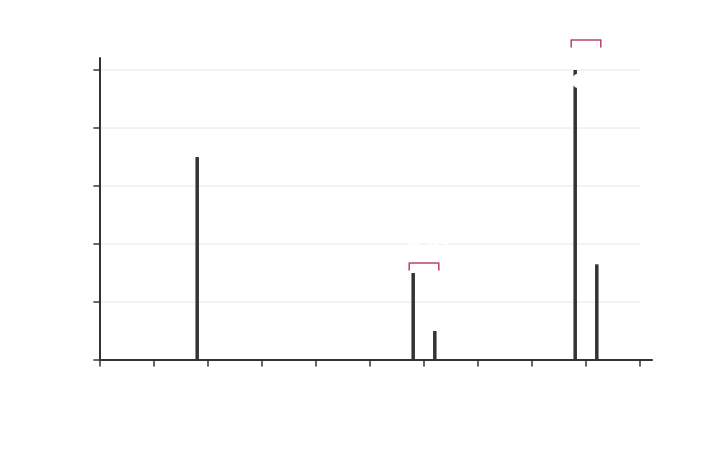
Molecular ion peaks• CH3CH235Cl+: 24 + 5 + 35 = m/z 64• CH3CH237Cl+: 24 + 5 + 37 = m/z 66The peak at 64 is three times the height of the peak at 66. This pattern (called the M and M+2 peaks) shows that the molecule contains one chlorine atom.Fragment peaks• m/z 49 and 51 (ratio 3:1): CH2Cl+, formed by loss of a methyl radical. The pair shows the fragment still contains chlorine.• m/z 29: C2H5+, formed when the molecular ion loses a chlorine atom. This peak is single, because the ion contains no chlorine.
C2H5Cl+ → C2H5+ + Cl•
Method: look for pairs of peaks 2 units apart. A 3:1 ratio means one Cl atom. Subtract 35 from the lower molecular ion value to find the mass of the rest of the molecule: 64 – 35 = 29, which is C2H5.

Read the text

Read the text and highlight anything you think is important. When you go on, the text is hidden and you answer from memory.

Specification: Edexcel Chemistry (8CH0), AS-level, Topic 7A: Mass spectrometry. Topic: Mass Spectrometry.

Key terms in this lesson

molecular ion
The positive ion formed when a whole molecule loses an electron in a mass spectrometer, giving a peak at the molecule's relative molecular mass.

More in Mass Spectrometry

All 9 lessons in Mass Spectrometry · All Edexcel AS-level Chemistry topics