Example 2: propanal and propanonePropanal, CH3CH2CHO, and propanone, CH3COCH3, are structural isomers with the formula C3H6O. Both have Mr = 58, so both show a molecular ion peak at m/z 58. The molecular ion alone cannot tell them apart, but their fragment peaks can.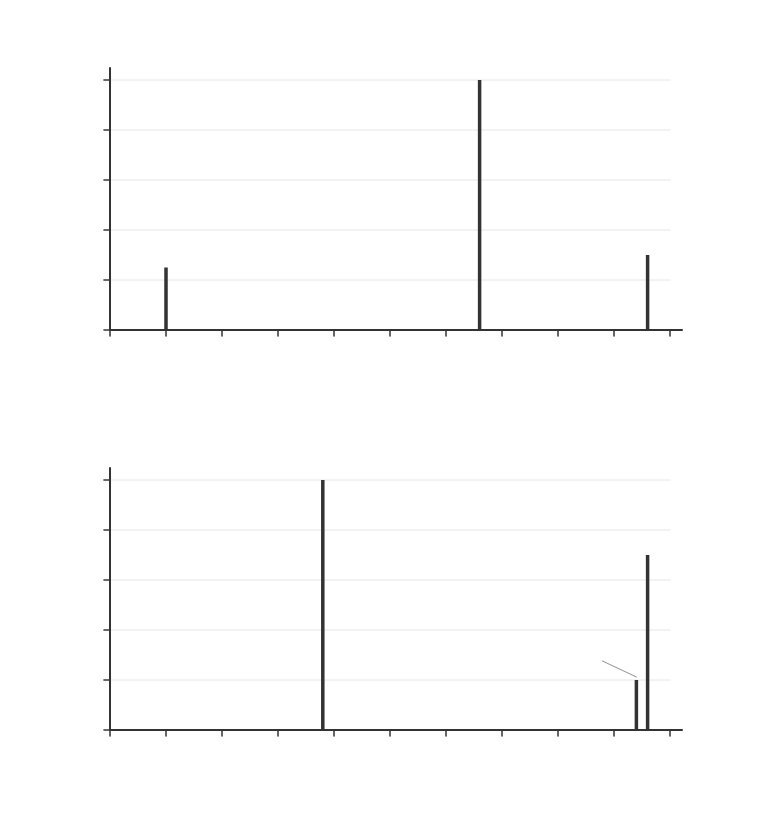
CH3COCH3+ → CH3CO+ + CH3• There is also a peak at m/z 15 from CH3+. Propanone has no ethyl group, so there is no significant peak at m/z 29.PropanalBreaking the C-C bond next to the C=O group gives C2H5+ and CHO+, which both have m/z 29, so propanal has a large peak at 29.CH3CH2CHO+ → C2H5+ + CHO• A peak at m/z 57 shows loss of a hydrogen atom (58 – 1) from the CHO group. Propanal has no CH3CO group, so there is no large peak at m/z 43.Conclusion: a C3H6O compound with a base peak at m/z 43 and no peak at 29 is propanone. One with a large peak at 29 and a peak at 57 is propanal.