Peaks with m/z values smaller than the molecular ion peak are a result of fragmentation. Fragmentation occurs when the molecular ion breaks into smaller pieces. When fragmentation occurs, 2 species are formed: 1. another positive ion 2. a neutral species (usually a radical).The molecular ion is written M+. A typical fragmentation is:M+ → X+ + Y• Only the positive ion X+ is detected, because the mass spectrometer only detects charged particles. The neutral radical Y• is not detected, so it gives no peak.The mass lost from the molecular ion helps to identify the fragment. A peak at M – 15 shows loss of CH3 (a methyl group), and a peak at M – 29 shows loss of C2H5 (an ethyl group). Common fragment ions are:• m/z 15: CH3+• m/z 29: C2H5+• m/z 31: CH2OH+• m/z 43: C3H7+ or CH3CO+Example: butane (Mr = 58)C4H10+ → C3H7+ + CH3• This gives a peak at m/z 43. Breaking the central C-C bond instead gives C2H5+ at m/z 29 and a C2H5• radical.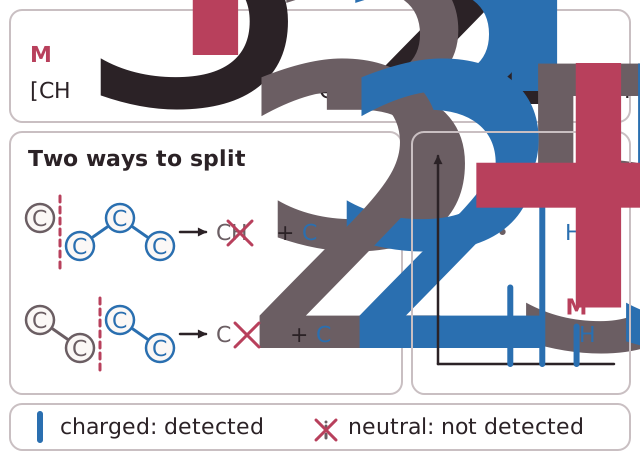 Each compound breaks up in its own pattern, so the fragment peaks can be used to work out structures and to tell isomers apart.