Example 1: ethanol, CH3CH2OH (Mr = 46)
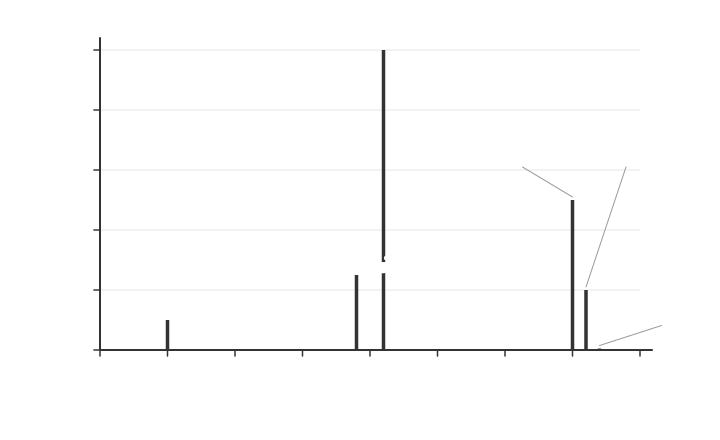
To interpret a mass spectrum, first find the molecular ion peak, then work out what each fragment peak has lost from the molecular ion.m/z 46: the molecular ion, CH3CH2OH+. This confirms Mr = 46. (A tiny peak at 47 is caused by carbon-13.)m/z 45: 46 – 45 = 1, so the molecular ion has lost one hydrogen atom, giving C2H5O+.m/z 31: the base peak. 46 – 31 = 15, the mass of CH3. The molecular ion has lost a methyl radical, leaving CH2OH+.CH3CH2OH+ → CH2OH+ + CH3• m/z 29: 46 – 29 = 17, the mass of OH. The molecular ion has lost a hydroxyl radical, leaving C2H5+.CH3CH2OH+ → C2H5+ + OH• m/z 15: CH3+.The peak at m/z 31 is typical of primary alcohols that contain the CH2OH group. Its appearance as the base peak, together with the molecular ion at 46, is strong evidence that the compound is ethanol and not its isomer methoxymethane, CH3OCH3, which has no CH2OH group.
Mass Spectrum Example 1
Read the text
Read the text and highlight anything you think is important. When you go on, the text is hidden and you answer from memory.
Specification: Edexcel Chemistry (8CH0), AS-level, Topic 7A: Mass spectrometry. Topic: Mass Spectrometry.
Key terms in this lesson
- base peak
- The tallest peak in a mass spectrum, corresponding to the most abundant, most stable fragment ion.
- molecular ion
- The positive ion formed when a whole molecule loses an electron in a mass spectrometer, giving a peak at the molecule's relative molecular mass.
More in Mass Spectrometry
- Mass Spectrometry
- The Molecular Ion Peak
- Other Peaks
- Fragmentation
- Mass Spectrum Example 2
- Mass Spectrum Example 3
- Mass Spectrum Example 4
- Mass Spectrum Example 5
All 9 lessons in Mass Spectrometry · All Edexcel AS-level Chemistry topics