Skip to content

Infra Red Spectrum - 8

Infrared spectrum 8: combining infrared and mass spectraAn unknown compound has the formula C3H8O. It could be propan-1-ol, CH3CH2CH2OH, or propan-2-ol, CH3CH(OH)CH3.
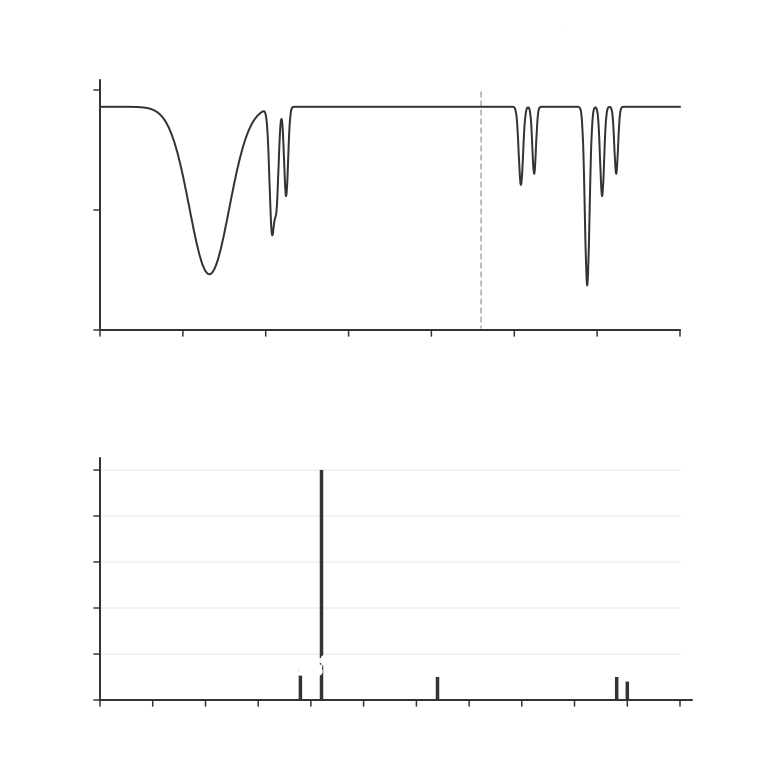
Step 1: infrared spectrumThe spectrum shows a broad absorption at about 3350 cm-1 (O-H) and no absorption near 1700 cm-1 (no C=O). The compound is an alcohol. Both isomers are alcohols, so the absorptions above 1500 cm-1 cannot tell them apart. Their fingerprint regions are different, but a known spectrum would be needed to compare them.Step 2: mass spectrumThe molecular ion peak is at m/z 60, which matches Mr(C3H8O) = 36 + 8 + 16 = 60.The base peak is at m/z 31. This is CH2OH+, formed when the molecular ion loses an ethyl radical (60 – 29 = 31):
CH3CH2CH2OH+ → CH2OH+ + C2H5•
Only a compound with a CH2OH group can form this ion.Answer: the compound is propan-1-ol. Propan-2-ol has no CH2OH group; it loses a methyl radical to give CH3CHOH+, so its base peak is at m/z 45 (60 – 15).Examiner tip: infrared identifies the functional group, and mass spectrometry gives the Mr and, through fragments, the carbon skeleton. Use them together and quote the evidence from each.

Read the text

Read the text and highlight anything you think is important. When you go on, the text is hidden and you answer from memory.

Specification: Edexcel Chemistry (8CH0), AS-level, Topic 7B: Infrared (IR) spectroscopy. Topic: Infra-red Spectroscopy.

Key terms in this lesson

molecular ion
The positive ion formed when a whole molecule loses an electron in a mass spectrometer, giving a peak at the molecule's relative molecular mass.
base peak
The tallest peak in a mass spectrum, corresponding to the most abundant, most stable fragment ion.

More in Infra-red Spectroscopy

All 10 lessons in Infra-red Spectroscopy · All Edexcel AS-level Chemistry topics