Skip to content

Infra Red Spectrum - 5

Infrared spectrum 5: following the oxidation of propan-1-olInfrared spectroscopy can show whether an oxidation has worked, and which product has formed, by looking for the O-H and C=O absorptions.
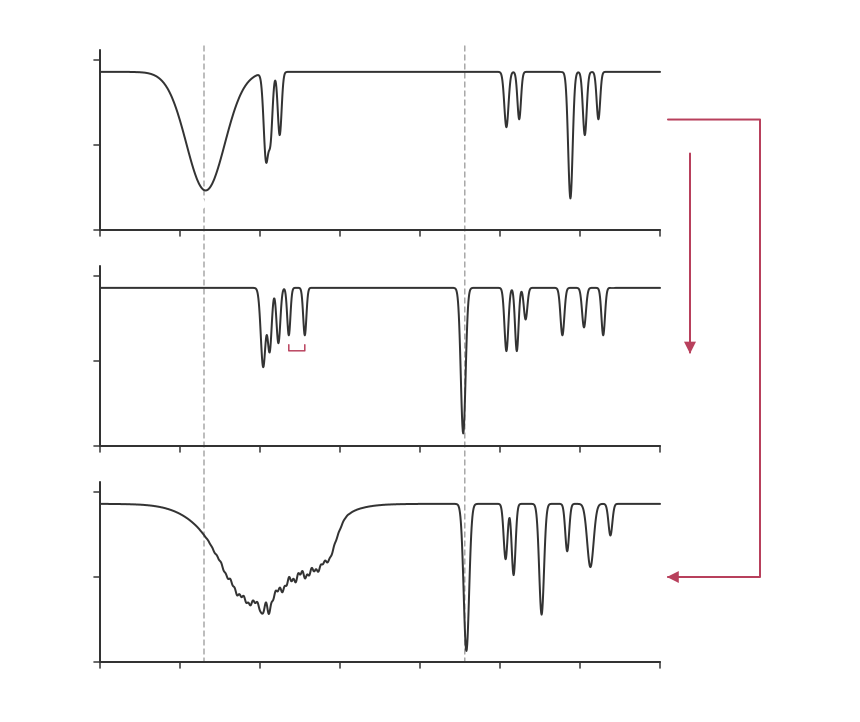
Spectrum A: propan-1-ol (starting material)Broad O-H absorption at about 3200 to 3550 cm-1. No C=O absorption near 1700 cm-1.Spectrum B: propanal (distilled off as it forms)Strong C=O absorption at about 1730 cm-1, with aldehyde C-H absorptions at about 2720 and 2820 cm-1. The broad O-H absorption has disappeared, which shows that the alcohol has been oxidised and no alcohol remains in the distillate.Spectrum C: propanoic acid (heated under reflux with excess oxidising agent)Strong C=O absorption at about 1710 cm-1 and a very broad O-H absorption from 2500 to 3300 cm-1.Using the spectra to check a product• If the distillate still shows a broad O-H absorption at 3200 to 3550 cm-1 as well as C=O, it is contaminated with unreacted alcohol.• If the aldehyde product shows a very broad O-H absorption from 2500 to 3300 cm-1, some of it has been oxidised further to the carboxylic acid.Summary: oxidising a primary alcohol makes the C=O absorption appear. Whether the O-H absorption then disappears (aldehyde) or becomes very broad and shifts to lower wavenumber (carboxylic acid) shows which product was made.

Read the text

Read the text and highlight anything you think is important. When you go on, the text is hidden and you answer from memory.

Specification: Edexcel Chemistry (8CH0), AS-level, Topic 7B: Infrared (IR) spectroscopy. Topic: Infra-red Spectroscopy.

Key terms in this lesson

aldehyde
An organic compound containing the -CHO group, in which a carbon-oxygen double bond lies at the end of the carbon chain.
carboxylic acid
An organic compound containing the -COOH functional group.

More in Infra-red Spectroscopy

All 10 lessons in Infra-red Spectroscopy · All Edexcel AS-level Chemistry topics