Infrared spectrum 6: cyclohexene from the dehydration of cyclohexanolCyclohexanol, C6H11OH, can be dehydrated by heating with concentrated phosphoric acid to form cyclohexene, C6H10. Infrared spectroscopy shows whether the reaction has worked.
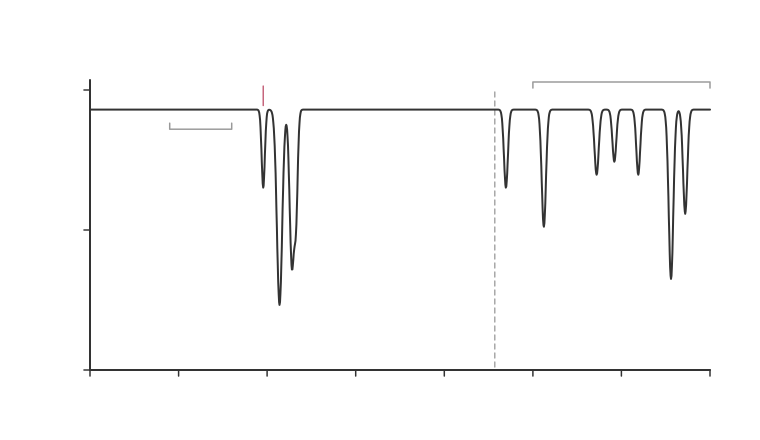
Spectrum of cyclohexene: key absorptions• A medium to weak absorption at about 1650 cm-1, caused by the C=C bond. Alkenes absorb at about 1645 to 1670 cm-1. This absorption is weaker than a C=O absorption, because the C=C bond is much less polar.• An absorption just above 3000 cm-1 (about 3020 cm-1), caused by the C-H bonds on the carbon atoms of the C=C bond. Ordinary C-H bonds in the CH2 groups absorb just below 3000 cm-1.What is missing• There is no broad O-H absorption at 3200 to 3550 cm-1, so no cyclohexanol is left in the product.• There is no strong absorption near 1700 cm-1, so there is no C=O. (Do not confuse the weaker C=C absorption at 1650 cm-1 with a C=O absorption.)ConclusionComparing the two spectra, the dehydration has worked if the broad O-H absorption of cyclohexanol has disappeared and new absorptions at about 1650 cm-1 and 3020 cm-1 have appeared. The C=C absorption can also be used to show that bromine water has reacted with an alkene: after the addition reaction, the absorption at 1650 cm-1 is gone.
Infra Red Spectrum - 6
Read the text
Read the text and highlight anything you think is important. When you go on, the text is hidden and you answer from memory.
Specification: Edexcel Chemistry (8CH0), AS-level, Topic 7B: Infrared (IR) spectroscopy. Topic: Infra-red Spectroscopy.
More in Infra-red Spectroscopy
- Characteristic Absorptions
- Infra Red Spectrum - 1
- Infra Red Spectrum - 2
- Infra Red Spectrum - 3
- Infra Red Spectrum - 4
- Infra Red Spectrum - 5
- Infra Red Spectrum - 7
- Infra Red Spectrum - 8
All 10 lessons in Infra-red Spectroscopy · All Edexcel AS-level Chemistry topics