Skip to content

Infra Red Spectrum - 4

Infrared spectrum 4: propanal, CH3CH2CHO
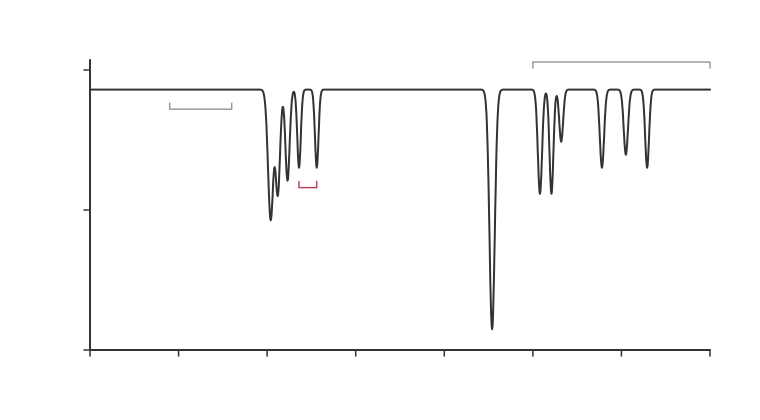
Propanal is an aldehyde. Like a ketone, it contains a C=O group, but the C=O carbon also has a hydrogen atom attached (the CHO group).Key absorptions• A strong, sharp C=O absorption at about 1730 cm-1. Aldehydes absorb at 1720 to 1740 cm-1, slightly higher than ketones (1700 to 1720 cm-1), but the ranges are close, so this alone is not enough to tell them apart.• Two weaker absorptions at about 2720 and 2820 cm-1. These come from the C-H bond of the CHO group. They are the clearest infrared evidence of an aldehyde, because ketones do not have them.• Normal C-H absorptions at about 2850 to 2980 cm-1.What is missingThere is no broad O-H absorption, so the compound is not an alcohol or a carboxylic acid.Worked exampleA compound C3H6O shows a strong absorption at 1730 cm-1, two weak absorptions at 2720 and 2820 cm-1, and no absorption between 3200 and 3550 cm-1. The C=O and the aldehyde C-H absorptions show that it is an aldehyde, so it is propanal and not its isomer propanone.

Read the text

Read the text and highlight anything you think is important. When you go on, the text is hidden and you answer from memory.

Specification: Edexcel Chemistry (8CH0), AS-level, Topic 7B: Infrared (IR) spectroscopy. Topic: Infra-red Spectroscopy.

Key terms in this lesson

aldehyde
An organic compound containing the -CHO group, in which a carbon-oxygen double bond lies at the end of the carbon chain.
ketone
An organic compound containing a C=O group bonded to two carbon atoms within the chain.

More in Infra-red Spectroscopy

All 10 lessons in Infra-red Spectroscopy · All Edexcel AS-level Chemistry topics