All metals are solid at room temperature with the exception of mercury.Metals:1. are malleable2. are ductile3. have high melting and boiling temperatures4. have good electrical conductivity5. are good thermal conductors
Most metals have strong metallic bonds, high electrical conductivity in the solid and liquid states and high melting and boiling points.
Metals are good conductors because electrons are mobile charge carriers and they can move through the lattice.When a potential difference is applied across the ends of the metal the delocalised electrons can MOVE towards the positive terminal.(electric current = moving charge).Delocalised electrons can MOVE and transfer kinetic energy from one part of the metal to another. The close-packed cations can vibrate and pass kinetic energy from one to the other so they have good thermal conductivity.
Melting point depends on the strength of the metallic bonds. Group 1 metals have the weakest bonds because only one electron per metal ion is involved in the bonding and the positive ion has a charge of +1. Metals have a giant lattice structure. There are many strong forces of attraction between the cations and delocalised electrons. The energy required to overcome these forces is very large. The melting temperature of group 1 < group 2 < group 3. As the number of delocalised electrons increases, the charge of cation (charge density) increases and there are stronger forces of attraction. d block metals have more delocalised electrons per ion so have stronger forces and higher melting temperatures.In addition, the smaller the cation, the closer the delocalised electrons are to the nucleus so the greater the melting temperature.Group 1 metals are soft. In contrast, magnesium is a much harder metal with the cation having a +2 charge and there being two delocalised electrons.
Metals are malleable and ductile. When a compressive or tensile stress is applied the layers can slide over each other. The delocalised electrons will move with the cations and prevent strong forces of repulsion forming between the layers.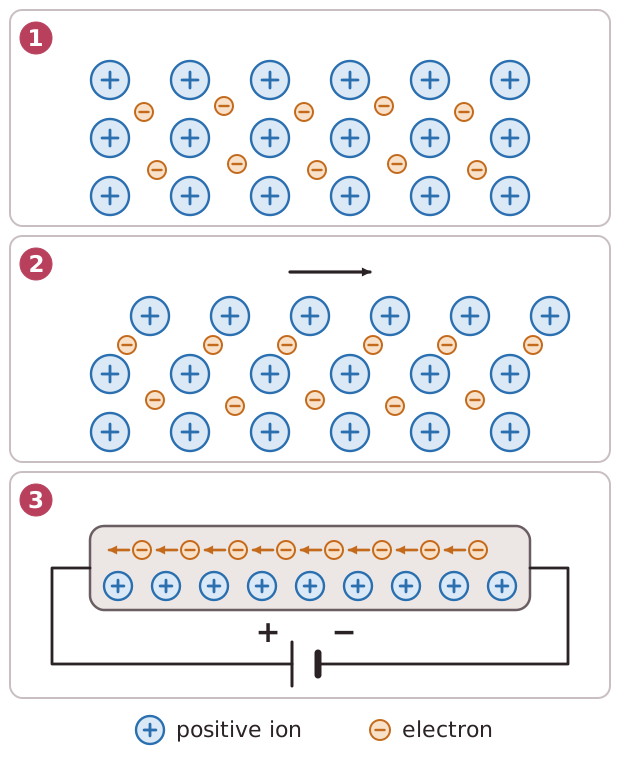 Metals do not dissolve in solvents, although some, such as the group 1 metals, react with water.
Most metals have strong metallic bonds, high electrical conductivity in the solid and liquid states and high melting and boiling points.
Metals are good conductors because electrons are mobile charge carriers and they can move through the lattice.When a potential difference is applied across the ends of the metal the delocalised electrons can MOVE towards the positive terminal.(electric current = moving charge).Delocalised electrons can MOVE and transfer kinetic energy from one part of the metal to another. The close-packed cations can vibrate and pass kinetic energy from one to the other so they have good thermal conductivity.
Melting point depends on the strength of the metallic bonds. Group 1 metals have the weakest bonds because only one electron per metal ion is involved in the bonding and the positive ion has a charge of +1. Metals have a giant lattice structure. There are many strong forces of attraction between the cations and delocalised electrons. The energy required to overcome these forces is very large. The melting temperature of group 1 < group 2 < group 3. As the number of delocalised electrons increases, the charge of cation (charge density) increases and there are stronger forces of attraction. d block metals have more delocalised electrons per ion so have stronger forces and higher melting temperatures.In addition, the smaller the cation, the closer the delocalised electrons are to the nucleus so the greater the melting temperature.Group 1 metals are soft. In contrast, magnesium is a much harder metal with the cation having a +2 charge and there being two delocalised electrons.
Metals are malleable and ductile. When a compressive or tensile stress is applied the layers can slide over each other. The delocalised electrons will move with the cations and prevent strong forces of repulsion forming between the layers.
Metals do not dissolve in solvents, although some, such as the group 1 metals, react with water.