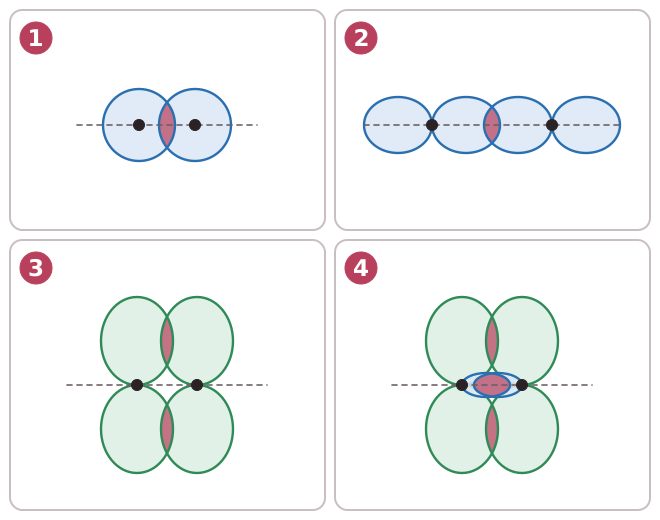
A covalent bond is the electrostatic attraction between two nuclei and a shared pair of electrons. Covalent bonds are formed from the overlap of two single electrons in two atomic s or p orbitals.Sigma bonds are formed from the end-on overlap of two s-orbitals, two p-orbitals or an s-orbital and a p-orbital. Pi bonds arise from the sideways overlap of 2 atomic p-orbitals.Pi bonds cannot form until sigma bonds are formed so lead to the formation of double or triple bonds.
Covalent Bonds
Read the text
Read the text and highlight anything you think is important. When you go on, the text is hidden and you answer from memory.
Specification: Edexcel Chemistry (8CH0), AS-level, Topic 2A: Bonding. Topic: Bonding.
More in Bonding
- Trends in Ionic Radii
- Physical Properties of Ionic Compounds
- Formation of Ions
- Evidence for the Existence of Ions
- π-bonds
- Bond Length and Bond Strength
- Electronegativity
- Distribution of Electron Density
All 15 lessons in Bonding · All Edexcel AS-level Chemistry topics