Evidence for ions is electrolysis. If a direct current is passed through green copper(II) chromate (VI) solution the blue Cu2+ cations migrate to the cathode and the yellow negative CrO42- anion goes to the anode.Migration of ionsA strip of filter paper on a microscope slide is soaked in a colourless electrolyte and a drop of copper(II) chromate(VI) solution is placed in the centre. The ends are connected to a d.c. supply. After some time a blue colour moves towards the negative electrode and a yellow colour moves towards the positive electrode.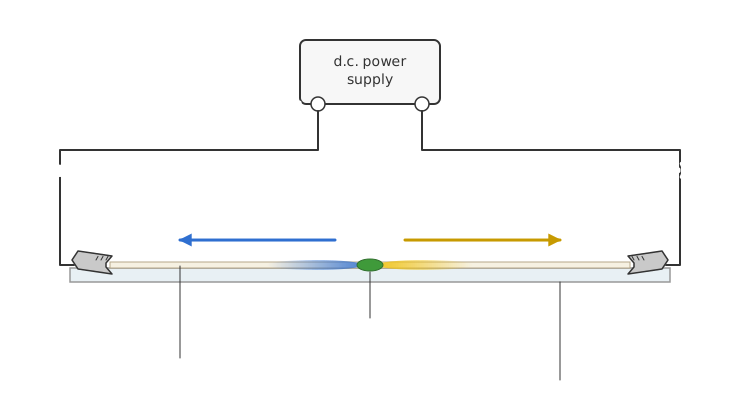
- the contours around each particle are almost spherical
- the electron density falls almost to zero between neighbouring particles, so no electrons are shared
- the contours around each chloride ion enclose a larger region than those around each sodium ion, because Cl– has 18 electrons and Na+ has 10