Electronegativity is the ability of an atom to attract a bonding pair of electrons.Electronegativity decreases down a group and increases across a period.
One of the bonded atoms may have a greater attraction for the shared pair of electrons than the other. The result is that the shared pair of electrons is not shared evenly and the electron cloud is distorted, so the bond becomes polar.
If the electronegativity difference is large enough (greater than 1.8) the more electronegative atom gains control of the electrons and the bond will become ionic rather than covalent.Electronegativity is measured on the Pauling scale.
Electronegativity increases across a period and up a group. Across a period the nuclear charge increases with similar shielding, and up a group the atomic radius and shielding decrease, so the nuclear attraction for the bonded pair of electrons increases. HCl is a polar covalent molecule as there is a difference in the electronegativities of hydrogen and chlorine.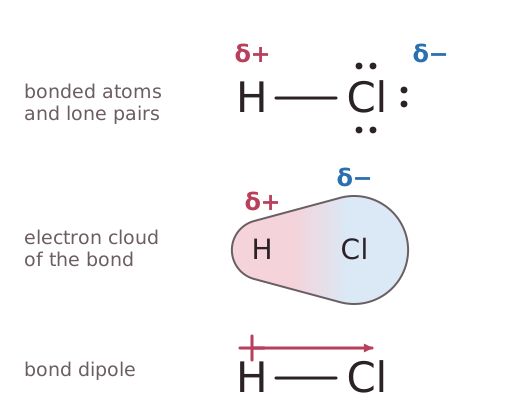
Electronegativity is the attraction of a bonded atom for the pair of electrons in a covalent bond.
One of the bonded atoms may have a greater attraction for the shared pair of electrons than the other. The result is that the shared pair of electrons is not shared evenly and the electron cloud is distorted, so the bond becomes polar.
If the electronegativity difference is large enough (greater than 1.8) the more electronegative atom gains control of the electrons and the bond will become ionic rather than covalent.Electronegativity is measured on the Pauling scale.
Electronegativity increases across a period and up a group. Across a period the nuclear charge increases with similar shielding, and up a group the atomic radius and shielding decrease, so the nuclear attraction for the bonded pair of electrons increases.