The C=C double bond in an alkene is made of two different kinds of covalent bond: one σ (sigma) bond and one π (pi) bond.A σ bond forms by the end-on (direct) overlap of orbitals, so its electron density lies directly between the two carbon nuclei. Every single covalent bond is a σ bond.A π bond forms by the sideways overlap of two p orbitals, one on each carbon atom. Its electron density sits in two regions, one above and one below the plane of the molecule.
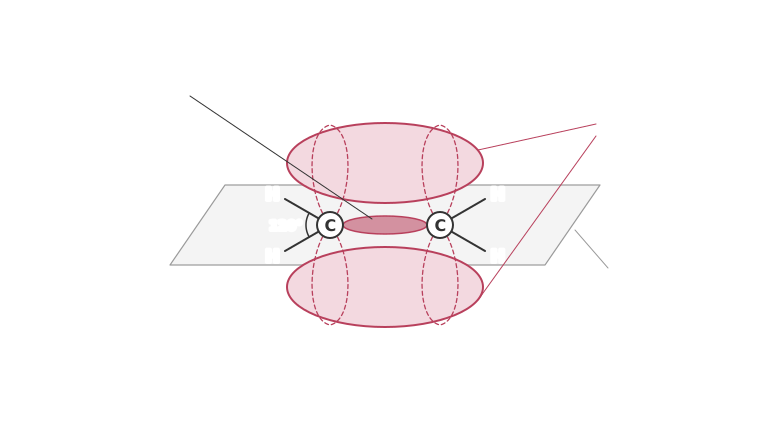
Because the p orbitals overlap less effectively than in a σ bond, the π bond is weaker. This is why the mean bond enthalpy of C=C (612 kJ mol−1) is less than twice that of C-C (347 kJ mol−1), and why alkenes are much more reactive than alkanes. The exposed π electrons form a region of high electron density that other species can attack.Each carbon of the C=C has three regions of electron density around it, so the arrangement is trigonal planar with bond angles of 120°. The two carbons and the four atoms attached to them all lie in one plane.The π bond also means there is restricted rotation about the C=C bond: turning one end would pull the p orbitals out of line and break the π bond. This is what makes E/Z isomerism possible.
Bonding in Alkenes
Read the text
Read the text and highlight anything you think is important. When you go on, the text is hidden and you answer from memory.
Specification: Edexcel Chemistry (8CH0), AS-level, Topic 6C: Alkenes. Topic: Alkenes.
Key terms in this lesson
- mean bond enthalpy
- The average energy needed to break one mole of a particular covalent bond, measured over a range of compounds, with all species gaseous.
More in Alkenes
- Alkenes
- Addition Reactions
- Hydrogenation
- Halogenation
- Hydration
- Addition of Hydrogen Halides
- Electrophile
- Nucleophile
All 19 lessons in Alkenes · All Edexcel AS-level Chemistry topics