The standard enthalpy of formation, ΔfH is the enthalpy change when one mole of compound is formed from its constituent elements in their standard states under standard conditions (298K and 100 kPa). The standard enthalpy change of any reaction can be obtained from the standard enthalpies of formation ΔHf of the reactants and products.For the reaction C2H4(g) + HCl(g) → C2H5Cl(g), the enthalpy of the reaction ΔH is given by
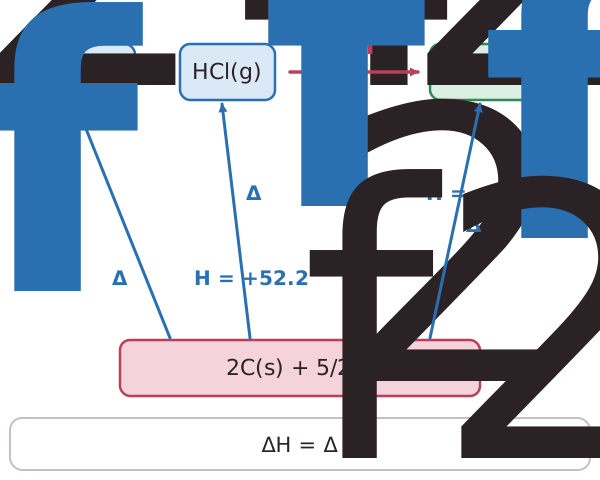
ΔHf C2H5Cl(g) - ΔHf C2H4(g) - ΔHf HCl(g)= -109 - (+52.2) - (-92.3)= -68.9 kJmol-1
The Enthalpy Change of Formation
Read the text
Read the text and highlight anything you think is important. When you go on, the text is hidden and you answer from memory.
Specification: AQA Chemistry (7404), AS-level, 3.1.4.1 Enthalpy change. Topic: Energetics.
Key terms in this lesson
- Mole
- The amount of substance that contains as many particles as there are atoms in exactly 12g of carbon-12.
- Enthalpy
- A measure of the heat energy stored in a chemical system.
- Enthalpy change
- The heat energy transferred between the system and its surroundings during a process carried out at constant pressure.
- Standard conditions
- A pressure of 100 kPa, a temperature of 298 K, and, for solutions, a concentration of 1 moldm-3.
More in Energetics
- Neutralisation Reactions
- Displacement Reactions
- Allowing for Heat Loss
- Hess's Law and Thermochemical Cycles
- The Enthalpy Change of Combustion
- Thermochemical Cycles and Enthalpy Diagrams
- Bond Enthalpies
- Using Mean Bond Enthalpies to Calculate Enthalpy Change
All 24 lessons in Energetics · All AQA AS-level Chemistry topics