 BRAINCAKE
The Enthalpy Change of Combustion
The standard enthalpy change of combustion is defined as: The enthalpy change when one mole of a substance in its standard state burns completely in oxygen under standard conditions of 298K and 100kPa pressure.
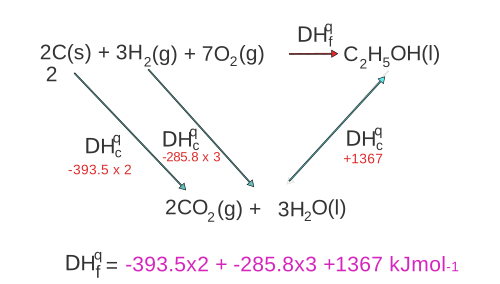
Sign in free to see the rest of this lesson, the R.E.C.I.P.E. recall steps and the quiz
BrainCake is free. Make an account in seconds and pick up where this page stops.
Key terms in this lesson
- Mole
- The amount of substance that contains as many particles as there are atoms in exactly 12g of carbon-12.
- Enthalpy
- A measure of the heat energy stored in a chemical system.
- Enthalpy change
- The heat energy transferred between the system and its surroundings during a process carried out at constant pressure.
- Standard conditions
- A pressure of 100 kPa, a temperature of 298 K, and, for solutions, a concentration of 1 moldm-3.
More in Energetics
- Displacement Reactions
- Allowing for Heat Loss
- Hess's Law and Thermochemical Cycles
- The Enthalpy Change of Formation
- Thermochemical Cycles and Enthalpy Diagrams
- Bond Enthalpies
- Using Mean Bond Enthalpies to Calculate Enthalpy Change
- Comparison with Thermochemical Cycles
All 24 lessons in Energetics · All AQA AS-level Chemistry topics