If a reaction can take place by two routes the total enthalpy change for each route is the same provided that the starting and finishing conditions are the same.Hess's Law is a consequence of the law of Conservation of Energy.Hess's Law states that the enthalpy change for a reaction is independent of the route taken, provided the initial and final conditions are the same.This lets us find enthalpy changes that cannot be measured directly, for example because the reaction is too slow, needs a very high temperature or gives unwanted side products.A thermochemical cycle (Hess cycle) links the reactants and products by a direct route and an indirect route through other substances. If A → B directly has ΔH1, and the indirect route goes A → C with ΔH2 and then C → B with ΔH3, then:ΔH1 = ΔH2 + ΔH3 When a route follows an arrow in the opposite direction to the one drawn, the sign of that enthalpy change is reversed.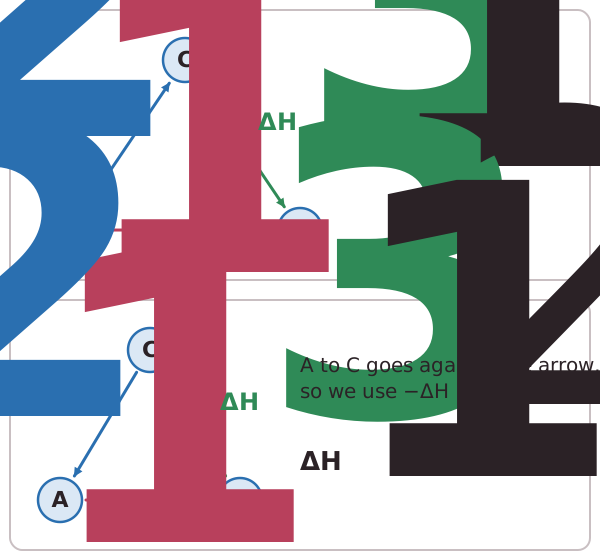 For example, if ΔH2 = -50 kJ mol-1 and ΔH3 = +20 kJ mol-1, then ΔH1 = -50 + 20 = -30 kJ mol-1.The most common cycles use enthalpies of formation or enthalpies of combustion.