 BRAINCAKE
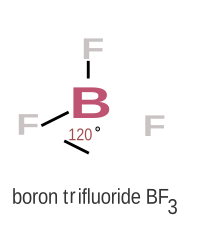
Three Pairs of Electrons
The maximum number of covalent bonds that can be formed by each atom sharing one of its electrons is equal to the number of outer shell electrons.
For group 2 and 3 this may result in the empty orbitals being used for dative covalent bonds.
Sign in free to see the rest of this lesson, the R.E.C.I.P.E. recall steps and the quiz
BrainCake is free. Make an account in seconds and pick up where this page stops.
Key terms in this lesson
- Atomic orbital
- A region in space around the nucleus where there is a 95% probability of finding an electron of a given energy.
- Covalent bond
- A strong electrostatic attraction between a shared pair of electrons and the nuclei of the bonded atoms.
- Electron pair repulsion theory
- The theory that electron pairs around a central atom arrange themselves as far apart as possible to minimise repulsion, determining the shape of the molecule or ion.
- Group
- A vertical column of the periodic table, containing elements with the same number of outer-shell electrons.
More in Bonding
- Boiling Point of Hydrides
- The Importance of Hydrogen Bonding
- Electron Pair Repulsion Theory
- Two Pairs of Electrons
- Four Pairs of Electrons
- Five Pairs of Electrons
- Six Pairs of Electrons
- Bonding-Pair Lone-Pair Repulsion
All 30 lessons in Bonding · All AQA AS-level Chemistry topics