Lone pairs affect the bond angle.Bonding pairs are attracted by both nuclei of the atoms forming the covalent bond but lone pairs are attracted only by the atom they belong to.Consequently the molecular orbital is much broader and the repulsion between lone pairs and lone pairs (lp-lp repulsion) or lone pairs and bonding pairs (lp-bp repulsion) is greater than repulsion between bonding pairs and bonding pairs (bp-bp repulsion).
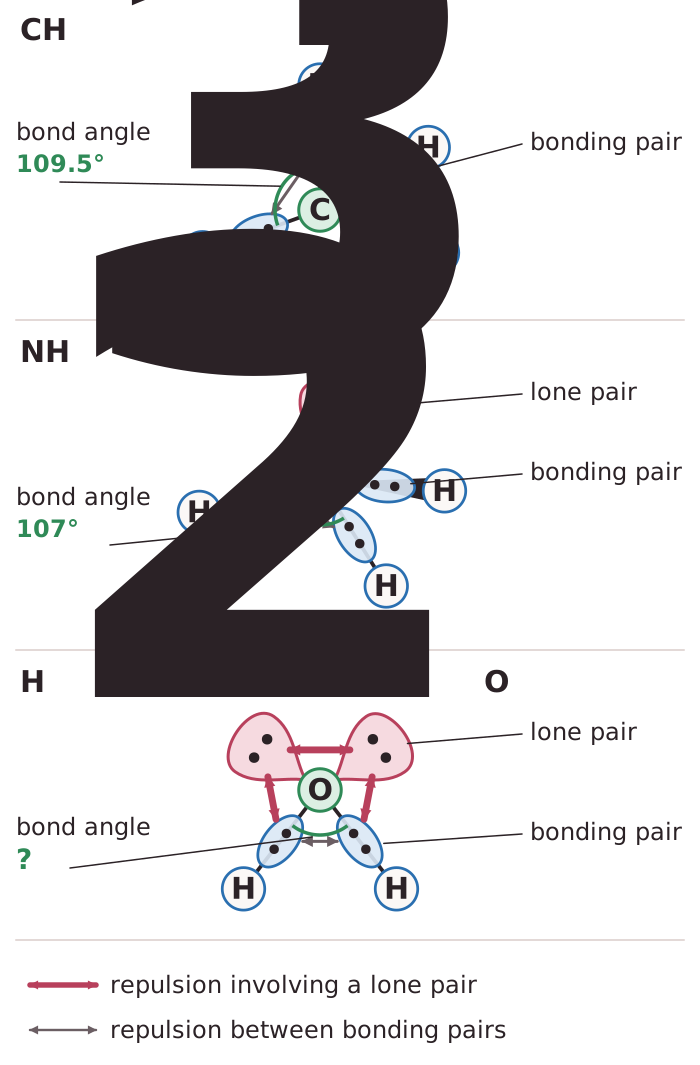
For each lone pair the bond angles are reduced by approximately 2.5°.
Bonding-Pair Lone-Pair Repulsion
Read the text
Read the text and highlight anything you think is important. When you go on, the text is hidden and you answer from memory.
Specification: AQA Chemistry (7404), AS-level, 3.1.3.5 Shapes of simple molecules and ions. Topic: Bonding.
Key terms in this lesson
- Atomic orbital
- A region in space around the nucleus where there is a 95% probability of finding an electron of a given energy.
- Covalent bond
- A strong electrostatic attraction between a shared pair of electrons and the nuclei of the bonded atoms.
- Lone pair
- A pair of outer-shell electrons that is not involved in bonding.
More in Bonding
- Three Pairs of Electrons
- Four Pairs of Electrons
- Five Pairs of Electrons
- Six Pairs of Electrons
- Heating a Solid, Liquid or Gas
- Crystals
- Diamond
- Graphite and Graphene
All 30 lessons in Bonding · All AQA AS-level Chemistry topics