Skip to content

Five Pairs of Electrons

PCl5 has three chlorine atoms around a central phosphorus atom arranged in a plane 120° apart and two atoms above and below the plane with a bond angle of 90° This shape is known as trigonal bipyramidal.
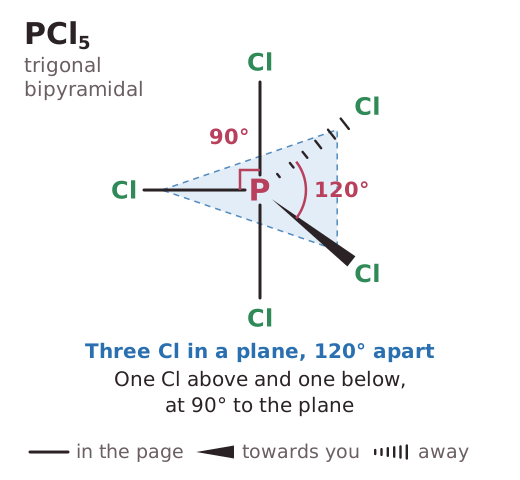
The octet rule and expanded octet rule determines how many valence electrons there are. In the PCl5 molecule, the central phosphorus atom is bonded to five Cl atoms, thus having 10 bonding electrons and violating the octet rule (trigonal bipyramidal).Some of the third-period elements (Si, P, S, and Cl) bond to more than four other atoms because for n=3, the d sublevel exists, and it has five d orbitals.Although the energy of empty 3d-orbitals is ordinarily higher than that of the 4s orbital, that difference is small and the additional d orbitals can accommodate more electrons. Therefore, the d orbitals participate in bonding with other atoms and an expanded octet is produced.

Read the text

Read the text and highlight anything you think is important. When you go on, the text is hidden and you answer from memory.

Specification: AQA Chemistry (7404), AS-level, 3.1.3.5 Shapes of simple molecules and ions and 3.1.3.2 Nature of covalent and dative covalent bonds. Topic: Bonding.

Key terms in this lesson

Atomic orbital
A region in space around the nucleus where there is a 95% probability of finding an electron of a given energy.
Period
A horizontal row of the periodic table, containing elements with the same number of electron shells.

More in Bonding

All 30 lessons in Bonding · All AQA AS-level Chemistry topics