 BRAINCAKE
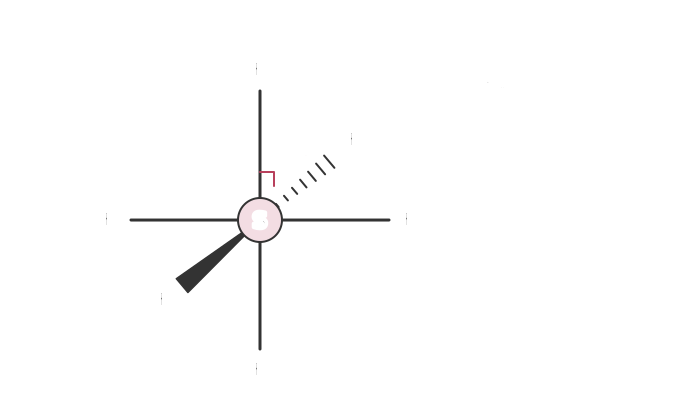
Six Pairs of Electrons
The octet rule and expanded octet rule determines how many valence electrons there are. In the PCl5 molecule, the central phosphorus atom is bonded to five Cl atoms, thus having 10 bonding electrons and violating the octet rule (trigonal bipyramidal).
Some of the third-period elements (Si, P, S, and Cl) bond to more than four other atoms because for n=3, the d sublevel exists, and it has five d orbitals.
Sign in free to see the rest of this lesson, the R.E.C.I.P.E. recall steps and the quiz
BrainCake is free. Make an account in seconds and pick up where this page stops.
Key terms in this lesson
- Atomic orbital
- A region in space around the nucleus where there is a 95% probability of finding an electron of a given energy.
- Period
- A horizontal row of the periodic table, containing elements with the same number of electron shells.
More in Bonding
- Two Pairs of Electrons
- Three Pairs of Electrons
- Four Pairs of Electrons
- Five Pairs of Electrons
- Bonding-Pair Lone-Pair Repulsion
- Heating a Solid, Liquid or Gas
- Crystals
- Diamond
All 30 lessons in Bonding · All AQA AS-level Chemistry topics