 BRAINCAKE
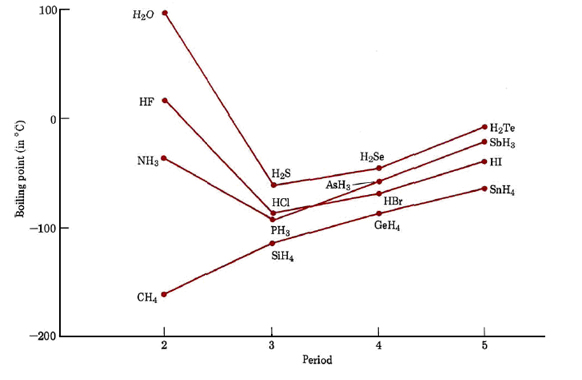
Boiling Point of Hydrides
The boiling points of hydrides generally increase across a period from groups 4 to 7. Group 4 hydrides are tetrahedral, non-polar covalent molecules such as methane. From group 5 to 7 the electronegativity increases and the molecules become more polar.
Sign in free to see the rest of this lesson, the R.E.C.I.P.E. recall steps and the quiz
BrainCake is free. Make an account in seconds and pick up where this page stops.
Key terms in this lesson
- Electronegativity
- The attraction of a bonded atom for the pair of electrons in a covalent bond, measured on the Pauling scale.
- Dipole
- A separation of opposite partial charges caused by an uneven distribution of the bonding electron pair.
- London forces
- Weak intermolecular forces caused by instantaneous dipoles inducing dipoles in neighbouring molecules.
- Hydrogen bond
- A strong permanent dipole-dipole interaction between a hydrogen atom bonded to N, O or F and a lone pair on an electronegative N, O or F atom of another molecule.
- Group
- A vertical column of the periodic table, containing elements with the same number of outer-shell electrons.
More in Bonding
- Polar Covalent Bonds
- Dipole-Dipole Forces
- Van der Waals forces
- Hydrogen Bonding
- The Importance of Hydrogen Bonding
- Electron Pair Repulsion Theory
- Two Pairs of Electrons
- Three Pairs of Electrons
All 30 lessons in Bonding · All AQA AS-level Chemistry topics