The three states of matter are solid, liquid and gas. Matter is anything with mass and it is made of tiny particles in constant motion.
| solid | liquid | gas |
| regular arrangement of particles | random arrangement of particles | random arrangement of particles |
| shapes have definite edges and crystals have straight edges | liquid changes shape to fill the container | will expand to fill the container |
| particles close together | particles fairly close together | particles far apart |
| not easily compressed | not easily compressed | easily compressed |
| vibrate about a point | jostle about rapidly | move rapidly in random directions |
| Solids expand on heating and diffusion is very slow. | liquids evaporate and diffusion is slow | diffusion is rapid and gases exert pressure |
Solids, liquids and gases expand on heating as the molecules move further apart and gain kinetic energy. Heating increases the kinetic energy and therefore the temperature of the material. Solids melt on heating. This is called fusion. The energy needed to melt a solid without a change in temperature is the
latent heat of fusion or the
enthalpy change of fusion(melting).
An
enthalpy change is the heat energy change measured at constant pressure.
Temperature depends on the average kinetic energy of the particles.
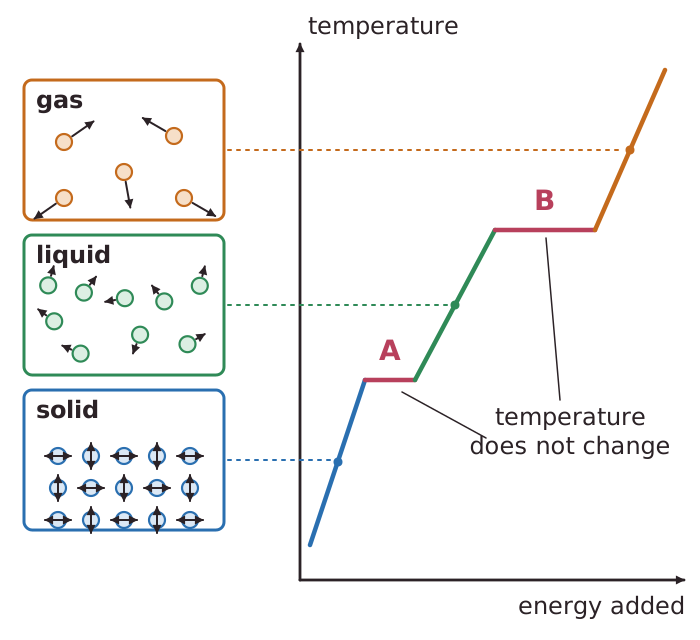
Heating a liquid turns it into gas. The energy required to change a liquid into a gas without a change in temperature is the
enthalpy change of vaporisation..