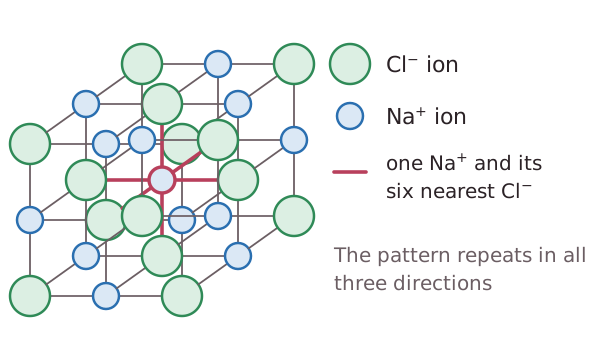
In an ionic compound each ion attracts oppositely charged ions in all directions. Ionic bonding is non-directional, so the ions build up into a regular, repeating three-dimensional arrangement called a giant ionic lattice.Each ion is surrounded by ions of the opposite charge and held in place by strong electrostatic forces of attraction. The lattice is described as giant because it contains an enormous number of ions, and there are no separate molecules.Sodium chloride has a cubic lattice. Each Na+ ion is surrounded by six Cl- ions, and each Cl- ion is surrounded by six Na+ ions.The formula of an ionic compound, such as NaCl or MgO, gives the simplest ratio of ions in the lattice rather than the number of atoms in a molecule. The lattice has no overall charge, because the positive and negative charges balance.