Alkenes react with steam to form alcohols. This hydration reaction is how most industrial ethanol is made:CH2=CH2(g) + H2O(g) ⇌ CH3CH2OH(g) ΔH = –45 kJ mol–1 Conditions: a phosphoric acid catalyst (H3PO4 on a solid silica support), a temperature of about 300 °C and a pressure of about 6 MPa (60 atm).The reaction is reversible and exothermic, so these are compromise conditions. A lower temperature would raise the equilibrium yield but make the reaction too slow. A higher pressure would also raise the yield (fewer moles of gas on the right) but costs more and causes ethene to polymerise. Only about 5% of the ethene reacts on each pass, so the ethanol is condensed out and the unreacted ethene is recycled, giving an overall conversion of about 95%.Mechanism: this is acid-catalysed electrophilic addition. An H+ from the acid is attacked by the C=C, forming a carbocation. A lone pair on a water molecule bonds to the positive carbon, and the resulting ion loses H+, which regenerates the catalyst.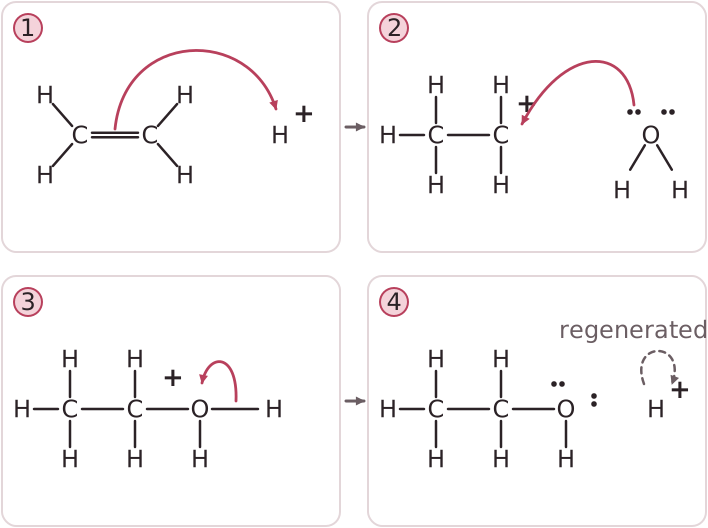 Atom economy: ethene and water form ethanol as the only product, so the atom economy is 100%. The drawback is that ethene comes from crude oil, a finite resource, whereas fermentation uses renewable sugars.Asymmetrical alkenes follow the carbocation rule: hydration of propene gives mainly propan-2-ol.