Skip to content

Addition Polymers

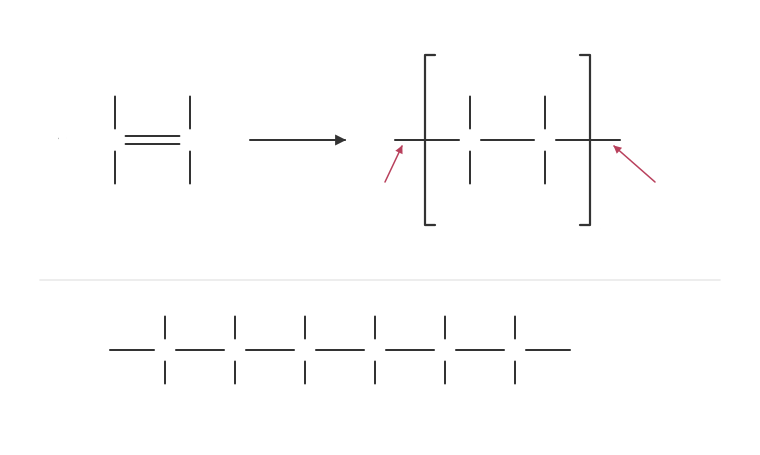
Alkenes and substituted alkenes can join together in very large numbers to form addition polymers. The small molecules are monomers, and each must contain a C=C bond. During polymerisation the π bond of each monomer breaks and new C–C single bonds link the monomers into a long chain. No other product is formed.
n CH2=CH2 → –[CH2–CH2]n–
The polymer is named by putting the monomer's name in brackets after 'poly': ethene gives poly(ethene), propene gives poly(propene), and chloroethene, CH2=CHCl, gives poly(chloroethene), known as PVC.Because no atoms are lost, the polymer has the same empirical formula as the monomer, and its Mr is the monomer's Mr times the number of monomers joined. For example, 1000 ethene molecules (Mr 28) form a chain with Mr 28 000.Poly(alkenes) are unreactive. Their chains are saturated, containing only strong, non-polar C–C and C–H bonds, so there is nothing for electrophiles or nucleophiles to attack. This makes them useful for containers and pipes, but also means they persist in the environment.PVC and plasticisers. Pure PVC is rigid and is used for window frames and drainpipes. Adding a plasticiser makes it flexible: the small plasticiser molecules get between the polymer chains, pushing them apart and weakening the intermolecular forces, so the chains can slide past each other. Plasticised PVC is used for electrical cable insulation and flooring.

Read the text

Read the text and highlight anything you think is important. When you go on, the text is hidden and you answer from memory.