An addition polymer chain is built from one small section that repeats over and over: the repeating unit. For a polymer made from a single alkene monomer, the repeating unit contains just two main-chain carbon atoms, the two that were joined by the C=C in the monomer.To draw the repeating unit from a monomer:
1. Draw the two C=C carbons in a row, with the other groups placed above and below them.
2. Change the C=C into a C–C single bond.
3. Add an extension bond on each side, drawn through square brackets, and write n after the brackets.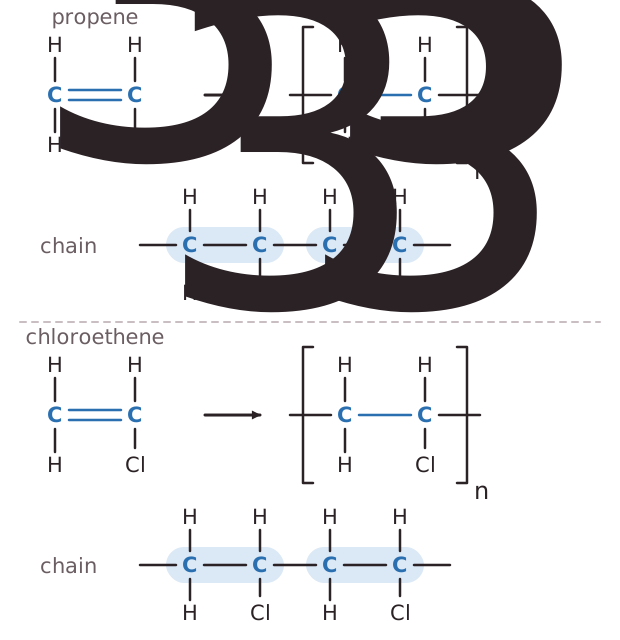 Any group that was not part of the C=C hangs off the main chain as a side group. It is never part of the backbone.Worked example: propene, CH2=CHCH3. The two C=C carbons become the backbone and the CH3 is a side group:
–[CH2–CH(CH3)]n– A common mistake is to put all three carbons in the chain; only two are in the backbone. The repeating unit contains the same atoms as the monomer, so poly(propene)'s repeating unit has the formula C3H6.More examples: chloroethene, CH2=CHCl, gives –[CH2–CHCl]n–; tetrafluoroethene, CF2=CF2, gives –[CF2–CF2]n– (PTFE).From a chain: look for the smallest section that repeats. In –CH2–CH(CN)–CH2–CH(CN)– the repeating unit is –CH2–CH(CN)–. Each repeating unit comes from one monomer molecule, so a chain of 500 units was made from 500 monomers.
1. Draw the two C=C carbons in a row, with the other groups placed above and below them.
2. Change the C=C into a C–C single bond.
3. Add an extension bond on each side, drawn through square brackets, and write n after the brackets.
Any group that was not part of the C=C hangs off the main chain as a side group. It is never part of the backbone.Worked example: propene, CH2=CHCH3. The two C=C carbons become the backbone and the CH3 is a side group: