 BRAINCAKE
Redox Potential
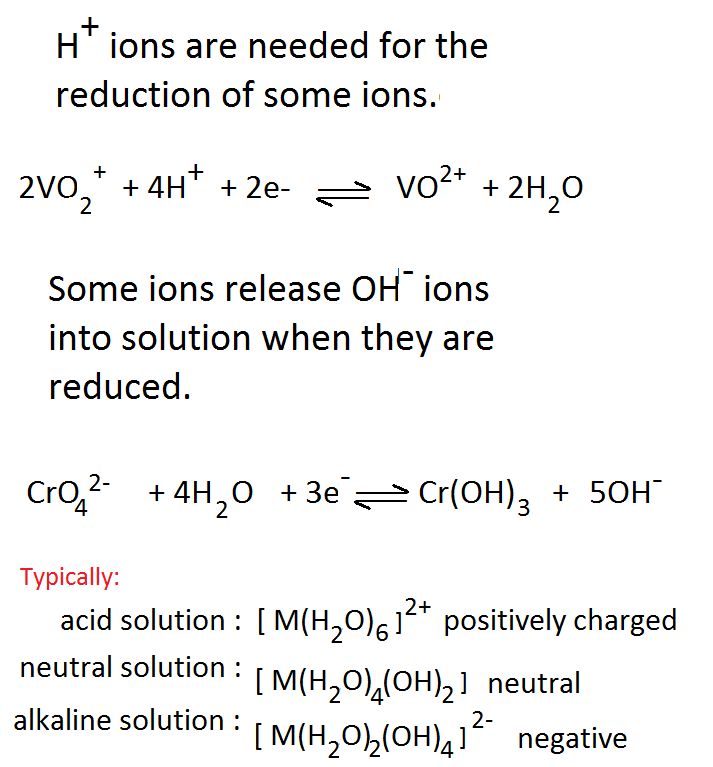
The redox potential of a transition metal is a measure of how easily it can be reduced to a lower oxidation state. The more positive the redox potential the more easily the reduction as the ion will be less stable. Metal ions in high oxidation states are only reduced in the presence of H+ ions so the redox potential is affected by pH. Usually, the more acidic the solution, the more positive the redox potential. Some ions release OH- when they are reduced. Oxidation of metal ions in lower oxidation states tends to happen in alkaline solution as there is a tendency to form negative ions and oxidation is loss of electrons.
Sign in free to see the rest of this lesson, the R.E.C.I.P.E. recall steps and the quiz
BrainCake is free. Make an account in seconds and pick up where this page stops.
Key terms in this lesson
- ligand
- An atom, ion or molecule that donates a pair of electrons to a central metal ion to form a co-ordinate bond.
More in Transition Metals
- Spectroscopy
- Ligand Substitution Reactions
- Vanadium
- Tollens Reagent
- Redox Titrations
- Heterogenous Catalysts
- Homogenous Catalysts
- Autocatalysis
All 21 lessons in Transition Metals · All OCR A-level Chemistry topics