If concentrated HCl is added to a solution of hexaaquacopper (II) ions the solution turns from blue to yellow. The high concentration of Cl- ions moves the position of equilibrium to the right. There is little enthalpy change because the Cu-O and Cu-Cl bonds are of similar strength.[Cu (H2O)6]2+ + 4Cl- ⇌ [CuCl4]2- + 6H2OWhen monodentate ligands are substituted with bidentate ligands the number of particles increases and the entropy is greater. Reactions that increase the total entropy are more likely to occur.Ligand substitution reactions are reversible and the equilibrium constant is called the stability constant.
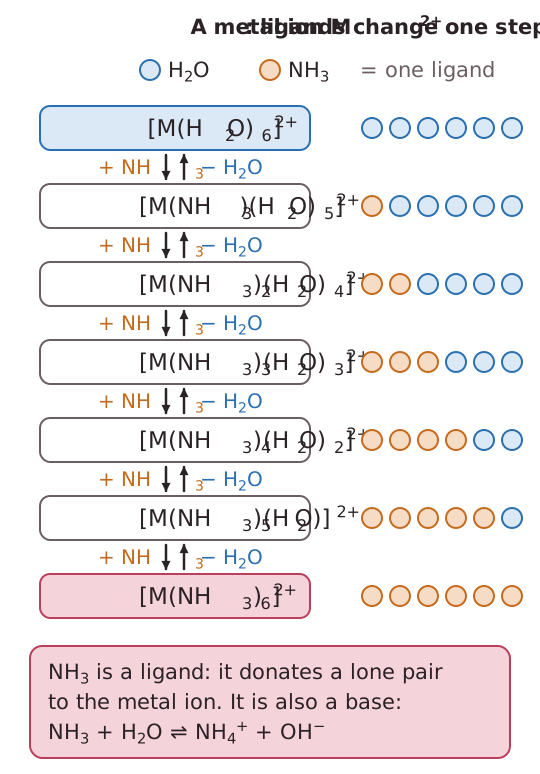
Ligand Substitution Reactions
Read the text
Read the text and highlight anything you think is important. When you go on, the text is hidden and you answer from memory.
Specification: OCR Chemistry A (H432), A-level, 5.3.1 Transition elements. Topic: Transition Metals.
Key terms in this lesson
- ligand
- An atom, ion or molecule that donates a pair of electrons to a central metal ion to form a co-ordinate bond.
- monodentate ligand
- A ligand that can donate only one pair of electrons, forming one co-ordinate bond with the central metal ion.
- bidentate ligand
- A ligand that can donate two pairs of electrons, forming two co-ordinate bonds with the central metal ion.
- entropy
- A measure of the number of ways particles and their energy can be arranged, or the degree of disorder of a system.
More in Transition Metals
- Shapes of complex ions
- Isomerism
- Formation of Coloured Ions
- Spectroscopy
- Vanadium
- Tollens Reagent
- Redox Potential
- Redox Titrations
All 21 lessons in Transition Metals · All OCR A-level Chemistry topics