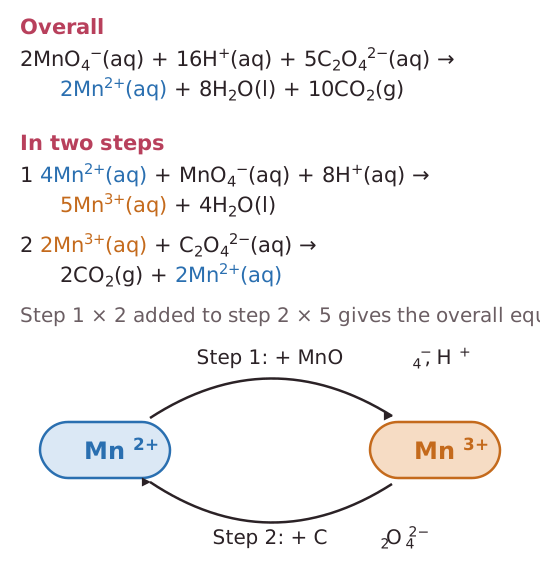
This occurs when one of the products of a reaction is also a catalyst for the reaction. Initially, the reaction proceeds slowly at the uncatalysed rate. As more and more catalyst is formed the reaction speeds up to the catalysed rate then proceeds like a normal catalysed reaction. Eventually, the reaction slows down as the reactants are used up.An example is the reaction between ethanedioic acid and an acidified solution of potassium manganate VII. The catalyst Mn2+ is formed and reacts with MnO4- ions to form an intermediate species Mn3+. The Mn3+ then reacts with the C2O42- ions to regenerate the Mn2+ ions.
Autocatalysis
Read the text
Read the text and highlight anything you think is important. When you go on, the text is hidden and you answer from memory.
Specification: OCR Chemistry A (H432), A-level, 5.3.1 Transition elements. Topic: Transition Metals.
Key terms in this lesson
- intermediate
- A species formed in one step of a reaction mechanism and used up in a later step, so it does not appear in the overall equation.
More in Transition Metals
- Redox Potential
- Redox Titrations
- Heterogeneous Catalysts
- Homogeneous Catalysts
- Hydration of Metal Ions
- Reaction with Ammonia Solution
- Reaction with Sodium Hydroxide
- Reaction with Sodium Carbonate
All 21 lessons in Transition Metals · All OCR A-level Chemistry topics